Cloudflare Error 1003: What It Means and How to Fix It
Tutorials

Eugenijus Denisov
Key Takeaways
-
Cloudflare Error 1003 appears when you try to access a site using an individual IP address instead of the domain, thus triggering Cloudflare protection systems.
-
This error mostly occurs due to misconfigurations, such as improper DNS records, applications, or plugins, or IPs used directly by bots or users who type them into the search bar.
-
To find a solution to this error, you can proxy your DNS, update your browser, firewall, or API or bot configuration to use the domain name instead of the IP address, and make sure your IP is not flagged as suspicious.
“Error 1003: Direct IP access not allowed.” You may be understandably confused when you see this error after trying to open a page. It generally means Cloudflare blocked the request because you tried to access this page directly using its IP address instead of the regular domain name.
When users see error 1003, it means they either don’t have access to crucial information or don’t make a purchase, depending on the site’s purpose. So what exactly does it mean? More importantly, how can you resolve Cloudflare error 1003? Keep reading to find out.
What Is Cloudflare Error 1003?
Cloudflare is a website security company that provides services intended to boost websites and networks’ security, performance, and reliability. It enforces strict rules and blocks requests that attempt to bypass them.
For instance, if you send too many requests within a short time frame, you may see Cloudflare error 1015 . And if you break any firewall rules, you may see Cloudflare error 1020 .
Cloudflare error 1003 is triggered when a user tries to access a site directly using the individual IP ( 104.18.27.120 ) instead of the domain, like example.com .
Cloudflare is designed to act as a protective proxy for websites. It hides the original server’s IP and manages traffic through its content delivery network, enforcing strict security and performance measures. That’s why it blocks direct access requests with the message “Direct IP access not allowed.”
What Are the Common Causes of Cloudflare Error 1003?
It’s important to note that website visitors and administrators can encounter error 1003. Here are some of the possible situations:
- Misconfigured DNS settings
For website administrators, you can proxy your DNS records or leave them as DNS-only in Cloudflare DNS configuration. If you mistakenly leave your records as DNS only, your server’s IP becomes visible to visitors. This allows attempting direct IP access to your website by anyone, triggering code 1003, which enforces security and proper routing.
- Typographical errors by visitors
Sometimes, users may type your website’s IP address directly into the address bar instead of links with your domain name. Doing so automatically triggers error code 1003, blocking access to the page.
- API or bot access using a direct IP address
APIs or bots may also be configured to send requests directly to the website’s IP instead of the domain. Cloudflare will block such requests and display error 1003.
- Misconfigured applications or plugins
It is also possible that some specific application integrations and plugins may be incorrectly configured to call the origin server’s IP address instead of the domain name, which is why these requests fail and display error 1003.
How to Identify Cloudflare Error 1003
If a request fails due to error 1003, Cloudflare typically presents an error page with specific details:
- Message: “Direct IP access not allowed.”
- Error code: The page prominently displays Error 1003, making it clear that this was the reason why your request failed.
- Cloudflare branding: You will see Cloudflare’s branding on the page, indicating that the error originated from Cloudflare’s network.
As an example, here’s what happens when you try to access IPRoyal’s website using an IP address instead of the URL:
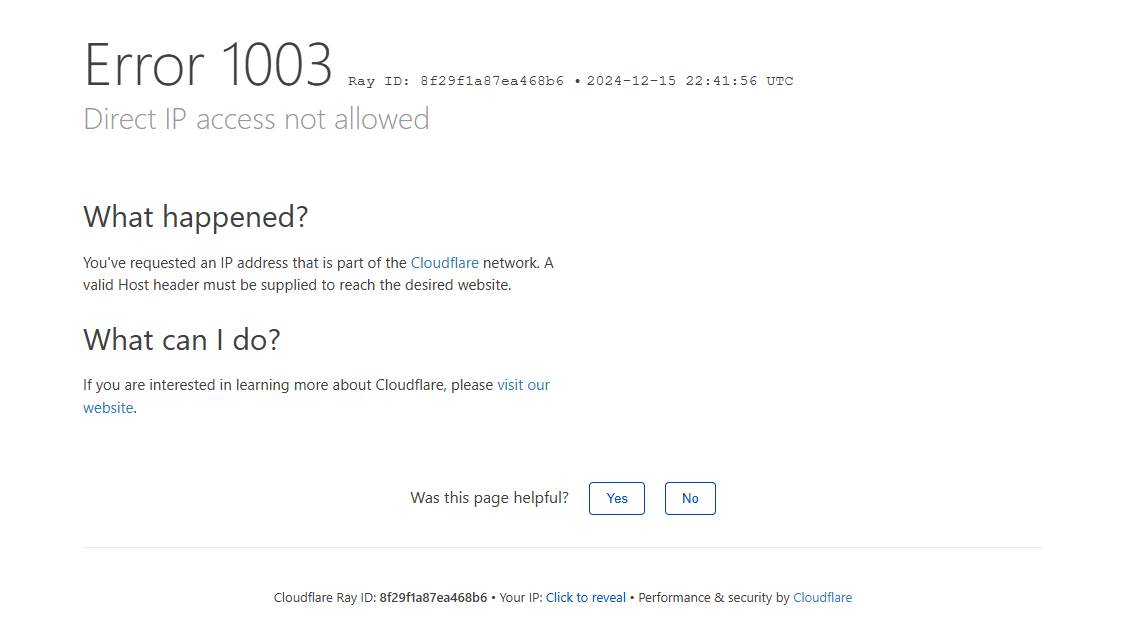
If you see this page after trying to access a specific website, it simply means that Cloudflare has blocked your request because you attempted to access the website using its IP, implying you are trying to bypass Cloudflare security mechanisms.
This error shouldn’t be confused with Error 1006 , which indicates that Cloudflare has blocked your IP address from accessing a website.
Diagnosing and Fixing Error Code 1003
So, what happens next? You must know that Cloudflare operates at the DNS and server level, so visitors cannot disable it from their browser. There are, however, a few ways you can fix Cloudflare error code 1003 from the server or client side of the system:
Cloudflare Dashboard
Cloudflare’s DNS system is like a phonebook for users because it simplifies website access by translating easy-to-remember domain names into the numerical IPs that servers use for communication. In doing so, it provides security and enhances the performance of websites.
You can configure Cloudflare’s DNS settings to proxy DNS records (indicated by an orange cloud icon) or leave them as DNS only (indicated by a grey cloud icon). Log into your Cloudflare dashboard for web administrators and ensure the DNS records are proxied.
Users may encounter this error because DNS is set to DNS only, exposing your server’s IP. Finally, check Firewall and security settings to ensure no misconfigured settings unintentionally block traffic.
Browser Developer Tools
Press F12 to open DevTools and go to the Network tab. Then reload the page and check the URL to see whether it resolves to the domain name’s IP address.
If it displays an IP, it means the browser is trying to access the server directly using that IP, which is why the error code is displayed.
To fix this problem, update the browser configuration to use the domain name instead of the IP. For APIs or scripts, check their settings or code and replace the IP with the domain name.
Web Server Logs
Another way to diagnose the problem is to analyze direct access attempts on the origin server.
This will require administrator privileges, so log in to your web server software and look for direct access attempts using the IP address. Next, identify whether these requests are from legitimate users or malicious actors, then correlate them to error code 1003.
Quick Summary on Finding a Solution
- Check your IP reputation and ensure it isn’t flagged as suspicious.
- Review Cloudflare firewall rules and both country and IP access settings.
- Confirm DNS settings and Cloudflare configuration are correct.
Conclusion
Cloudflare error 1003 occurs when someone tries to access a website using its IP address rather than its domain name. These requests get automatically blocked by Cloudflare because they attempt to get around Cloudflare’s security and performance checks.
It is our hope that you understand how these errors occur and what you can do to fix them should they happen.
FAQ
Is Cloudflare Error 1003 an IP ban?
No. Error 1003 means Cloudflare is blocking access due to IP reputation or configuration rules, not that your IP is permanently banned. The block can be temporary or based on specific firewall settings.
Does Error 1003 go away on its own?
It can go away sometimes, depending on circumstances. If the block is due to temporary conditions like suspicious traffic or an ISP issue, it may resolve itself. If it’s caused by Cloudflare settings, only the site owner can fix it.
Can I disable Cloudflare from my browser?
No. Cloudflare operates at the DNS and server level, so visitors cannot disable it from their browser. Changes must be made by the site owner in Cloudflare’s dashboard.
Why is Cloudflare blocking me?
Cloudflare may block you due to IP reputation, security rules set by the site owner, rate limits, or detected malicious behavior. These protections help defend the site against abusive traffic.