Residential vs Datacenter Proxy: An In-Depth Comparison
Proxy fundamentals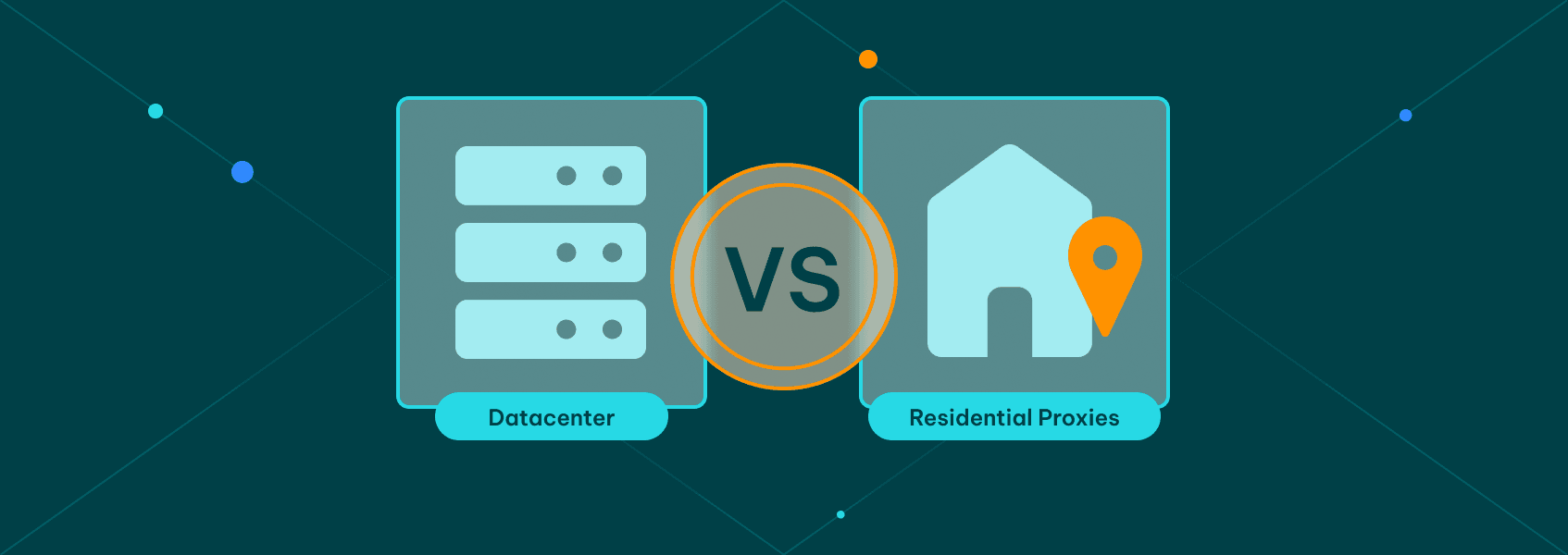

Vilius Dumcius
Key Takeaways
-
Datacenter proxies are created using virtual machines in data centers with commercial internet connections.
-
Residential proxies use IP addresses assigned by consumer internet service providers to real household devices.
-
Use datacenter proxies for speed-critical, low-security tasks and residential proxies when stealth and success rate matter more than speed and cost.
Proxy servers transform how you use the internet by masking your real IP address and the information linked to it. While the function is nearly identical across proxy types, the benefits differ. Datacenter and residential proxies are the two most popular types with diverse sets of benefits.
Residential proxy vs datacenter proxy comparison comes down to your use cases, budget, and needed level of security. Simply understanding the differences isn’t enough - you must also know how the choice between these proxy servers will shape results.
If you prefer the video format, we have you covered:
Datacenter vs Residential Proxies - What Are They?
A proxy server is an intermediary that sits between a client, such as your PC, and the internet. It conceals the client’s IP address by forwarding requests and responses on his behalf. All proxy types, except for reverse proxies , accomplish the same task, but different IP sources across types provide distinct benefits.
Datacenter proxies and residential proxies use different devices and internet connections to create proxy IP addresses. The first is based on virtual machines in commercial data centers, and the other on household devices in residential areas.
What Is a Datacenter Proxy?
A datacenter proxy is hosted in data centers where one powerful server can run hundreds of virtual machines with proxy IPs. Such cloud centers aren’t associated with any residential Internet Service Provider (ISP) or ordinary device. Instead, datacenter proxies run on powerful hardware with commercial internet connections.
Such setups often rely on colocation facilities with N+1 power and cooling, high-capacity connectivity, and always-on DDoS protection across multiple global regions.
Due to their setup, datacenter proxies are popular for use cases like large-scale web scraping, SEO, and price monitoring. They are also great for accessing geo-restricted content, as most providers have plenty of servers around the world.
It’s common to buy datacenter proxies in bulk and share the connection with other users. Datacenter IPs are comparatively cheap and can perform well under great bandwidth and speed demands. However, datacenter proxy IPs aren’t particularly effective at avoiding blacklists or concealing proxy usage.
Many anti-bot systems can quickly notice patterns from datacenter proxies and flag entire IP ranges. Datacenter proxy IPs come in allocated contiguous blocks with similar prefixes. When one IP address misbehaves, a site can block the entire subnet.
Best datacenter proxy providers , such as IPRoyal, lower the chances of blocks by rotating datacenter proxies and using only the highest quality IP pools. Yet a higher chance of blocks remains a major difference from residential proxies and influences many proxy users’ choices.
Top Speeds With Zero Bandwidth Limits
Premium Datacenter Proxies
What Is a Residential Proxy?
When an internet service provider (ISP) connects your home or office to the internet, they allocate an IP address to a modem, which then assigns IP addresses to other devices within the network. Most IPs are dynamically assigned and change over time, but ISP registry data is available, enabling database creation and location detection.
Residential proxies are intermediary servers that route your traffic through IP addresses assigned by ISPs to household devices, such as PCs. Think of it as a way to borrow your friend’s residential IP address for changing your location and ensuring better online privacy.
There’s more to what residential proxies are , but it gives us an understanding of the main benefits and differences to datacenter proxies. Each residential IP is tied to a physical device with accurate location targeting. Most other website visitors use the same IPs, so you’ll face fewer restrictions and better blend in.
Privacy increase comes with a cost, however, as residential proxies are slower, their maintenance is more expensive, and a single IP address is less reliable. It’s more common for residential proxies to be dedicated and used for high-value tasks or scraping websites with aggressive anti-bot systems.
Global Pool, Precise Targeting, Zero Contracts
Premium Residential Proxies
When to Use Datacenter vs Residential Proxies
Choose datacenter proxies when you care most about speed, low costs, and target websites that don’t use aggressive anti-bot systems or IP reputation checks. Invest in residential proxies when stealth and a large IP pool are a priority, or when you need realistic geo-location and help mimicking real user behavior.
The general rule of thumb allows us to categorize common proxy uses for one or the other type. Although many tasks, such as web scraping, SEO, and others, can apply to both on different scales.
When to choose datacenter proxies:
- Large-scale web scraping
- General SEO monitoring and rank tracking
- Price monitoring
- QA testing
When residential proxies are a better choice:
- Web scraping highly protected targets
- Ad verification
- Social media monitoring
- Precise geo-targeted data collection
- Bulk purchasing
Cost and Pricing Models
Datacenter proxies are generally much cheaper, with some proxy providers charging less than a dollar per IP address. The pay-per-IP model is typical for most dedicated datacenter proxies. As of 2026, prices range from $1.00 to $2.50 per IP address for one month, depending on the period length.
Another less common pricing model of datacenter proxies is pay-per-GB, which is found in shared and rotating datacenter proxy networks. The typical range across providers is $0.60 to $1.50 per GB of bandwidth used.
For most use cases, this is a less convenient pricing model since datacenter proxies are more fit for uses where lots of bandwidth is needed. Still, no matter how you look at it, datacenter proxies are much cheaper than residential proxies.
Typical pricing of residential proxies is based on a pay-per-GB model, since bandwidth is scarce and costly on residential connections. Currently, the prices of quality providers fall between $4.00 to $15.00 per GB used.
Pay-per-IP options with unlimited bandwidth are rare and more common with static residential proxies (ISP proxies). They can cost up to 4 times as much as traditional residential proxies, which are already a few times more expensive than datacenter proxies. The price difference can be explained by how IPs are sourced and operated.
- Real device sourcing that residential proxies are based on is much more expensive than acquiring datacenter IP ranges in bulk.
- Ethical standards are significantly higher for residential proxies, as individuals who share their IP addresses must clearly consent and be compensated.
- Operational costs of residential proxies are higher due to the costs of bandwidth and more sophisticated software required to manage such large pools.
- Higher success rates of residential proxies mean their IP addresses are more in demand, and users are willing to pay more for premium reliability.
If you’re comparing dedicated residential options with lower-cost infrastructure, our ISP vs Datacenter proxies guide explains the key differences.
Datacenter vs Residential Proxies: Key Differences
Choosing between datacenter and residential proxies comes down to a few key differences that you must consider. Datacenter proxies are more available and less expensive. Consider whether at least some of the differences below are important to you before investing in residential proxies.
- Accessing geo-restricted content. Residential proxies are assigned by ISPs to household devices, so they bypass geo-blocks more easily. Datacenter proxies generally have smaller location coverage and are blocked more easily.
- Location availability. Residential IP addresses are available in almost all corners of the world, so residential proxies often give you a greater range of accurate IP locations worldwide.
- Speed. Residential proxies are not as fast as datacenter proxies, as their speed is limited by the internet connections, household devices, and their locations more than datacenter proxies.
- IP legitimacy and trust. Residential IP addresses come from real homes, served by consumer ISPs, so websites will treat you as a legitimate user. As a result, residential proxies, when combined with other tools, are harder to track and offer greater online privacy.
- Block rates. Since residential proxy IP addresses are more legitimate, security and anti-bot systems are less likely to block or use CAPTCHAs. High-security websites, such as social media, will likely require residential proxies for scraping or other tasks.
| Datacenter Proxies | Residential Proxies | |
|---|---|---|
| Cost model | Pay-per-IP (dedicated) or Pay-per-GB (shared/rotating) | Pay-per-GB |
| Price range | $1.00-$2.50 monthly per IP $0.60–$1.50 monthly per GB | $4–$15 monthly per GB |
| Speed | Very fast. Consistently low latency | Moderate. Response times may vary |
| Location availability | Limited to major data center hubs | Extensive global coverage (city-level targeting) |
| Block rate | High. Datacenter IP addresses are easy to blacklist | Very low. Residential IP addresses are rarely blacklisted |
| Trust level | Low. Commercial origin visible | High. ISP-registered, treated as a real user |
| Best use cases | SEO monitoring, price tracking, QA testing, load testing, light scraping | Social media management, ad verification, sneaker bots, complex scraping projects, and bypassing geo-blocks |
| Scalability | Excellent for high-concurrency tasks | Limited by the home connection quality |
Conclusion
Once you’ve made your choice, it’s important to find a trustworthy proxy service provider that can help you test different datacenter and residential proxy variations for your use cases. At IPRoyal, we offer you all the main proxy server types.
Static or rotating proxies give you real IPs in different countries for longer periods or on a set rotation. Shared or private proxies allow you to save or get exclusive access. It also allows users to choose between HTTP(S) and SOCKS5 protocols. We’re sure you’ll find a suitable proxy setup.