5G vs 4G: A Comparative Guide to Get to Know Your Networks Better
Expert corner

Alwayne Powell
Key Takeaways
-
5G is faster than 4G LTE in most real-world conditions, with average speeds of around 80 to 210 Mbps compared to 10 to 50 Mbps on 4G, and latency drops from 30 to 50 ms to about 10 to 20 ms.
-
High-band 5G delivers gigabit speeds but has a short range and struggles indoors, so outside major cities your phone will often fall back to 4G LTE.
-
Most new phones switch between 5G and 4G automatically, so the difference mainly matters if you rely on mobile hotspots, high-resolution streaming, or large file transfers.
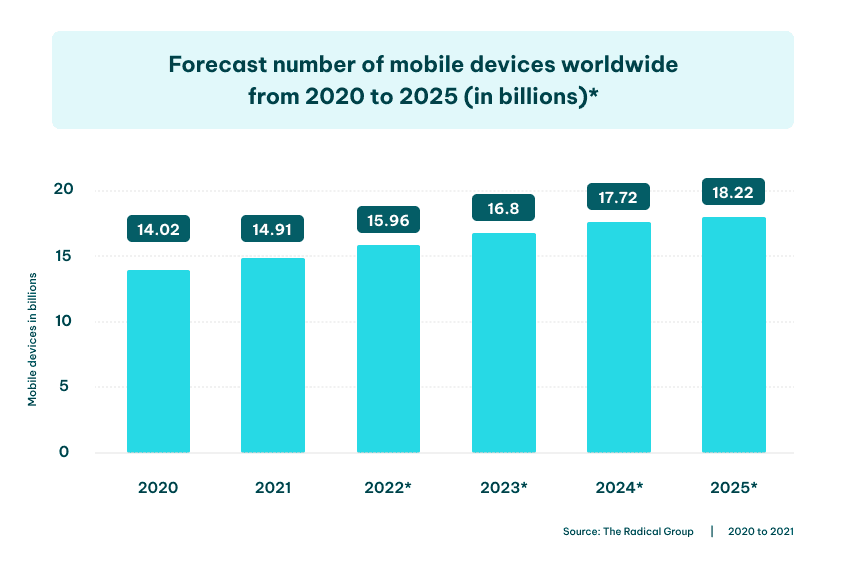
The world is more connected today than ever before. In fact, the number of connected devices in the Internet of Things (IoT) is forecast to reach 21.9 billion in 2026 .
You could say we take that connection and those devices for granted. The reality is that we rely on them more and more for so many things we do on a daily basis.
From checking the weather to ordering a food delivery, from shopping for a new jacket to stopping invading alien hordes. We use our cellphones not only to communicate with others but to access every corner of the internet, do our shopping, or just play games.
Those devices also play a large role in business activities, and IP technology means you can have a business phone line that is not dependent on your location.
How often do you stop and think about the connections and mobile networks that make all this possible? You may occasionally check to see how strong your signal is, but do you think about the tech that makes it work? In particular, you may hear comparisons like 5G vs. 4G, but what do they mean to you and your mobile device?
5G vs. 4G LTE Specifications
| Feature | 4G LTE | 5G |
|---|---|---|
| Peak theoretical speed | Up to 1 Gbps | Up to 20 Gbps |
| Real-world speed | 10 to 50 Mbps | 80 to 210 Mbps on average, with mmWave exceeding 1 Gbps |
| Latency | 30 to 50 milliseconds | 10 to 20 milliseconds (targets 1 ms for specialized uses) |
| Connection density | Up to 100,000 devices per square kilometer | 1,000,000 devices per square kilometer |
| Spectrum bands | Sub-6 GHz | Low-band, mid-band, and high-band (mmWave) |
| Coverage range | Broad national coverage | Broad national coverage, with gigabit speeds concentrated in dense areas |
| Energy efficiency | Less efficient per bit, but widespread signal stability preserves battery | Highly efficient per bit, but searching for weak signals in fringe areas causes drain |
| Device support | Universally supported | Standard on almost all new smartphones, including budget models |
| Typical use cases | Web browsing, standard streaming, and casual app usage | Industrial automation, ultra-HD streaming, and smart city infrastructure |
What Is 4G and 5G (And How Does It Work)?
It’s actually very simple terminology. The ‘G’ in 4G and 5G stands for generation, so each new generation is assigned a numerical identifier. 4G is fourth-generation technology and 5G is fifth-generation tech.
The cellular technology that lies behind those monikers is based on the same radio technology that the world has been using for more than 120 years.
While Nikola Tesla was the first person to demonstrate a wireless radio in 1893 , most people acknowledge Guglielmo Marconi as the inventor, mainly because he applied for the first patent for the technology in England in 1896 (granted in 1897).
Jump forward some 80 years, and NTT (Nippon Telegraph and Telephone) launched the first mobile phone network in Japan in 1979. That network was 1G.
Since then, technology has made huge strides forward. The network is what helps your mobile device stay connected, but despite all that progress, the same basic principles apply to how your cellular networks operate. Any network consists of three main parts that mean you can use your mobile phone efficiently.
- RAN (Radio Access Network): This is what your phone connects to. Its points of ‘contact’ are the numerous antennas that you see dotted around the countryside or on urban rooftops.
- Core network: This is the central part of your network that enables connection to the internet or, in the case of calls, to the person you want to speak to.
- Transport network: This is what connects your RAN with the core network.
Now for the geeky part. Radio has been mentioned several times, so what exactly do we mean? Radio waves are similar to light in that they are both electromagnetic waves, though radio waves operate at much lower frequencies than light.
This means that they can travel through walls, around corners, and so on, making them ideal for mobile device communication.
What often surprises people, or laypeople at least, is how little power is required to operate mobile communications. For example, a 5G antenna uses anywhere from 1 watt to a few hundred watts. Your actual mobile device uses even less power, often as little as 0.2 watts.
5G vs. 4G: What’s the Difference?
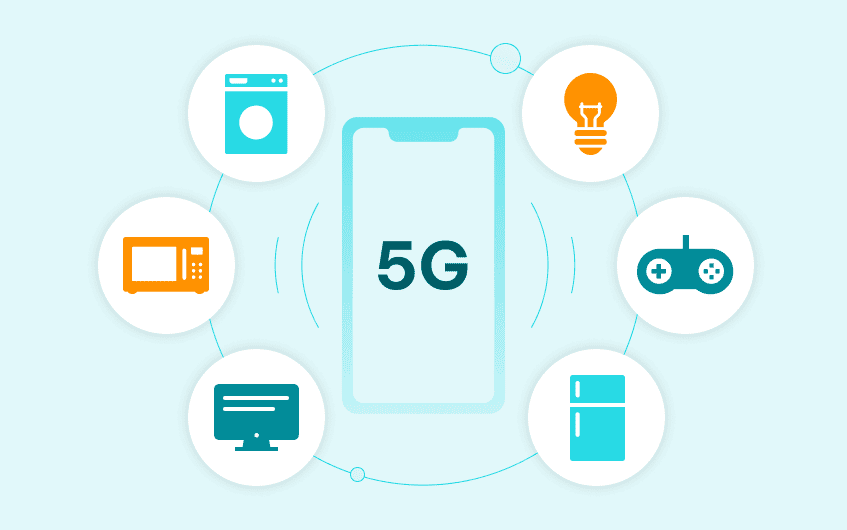
Speed
4G networks typically offer download speeds between 10 Mbps and 50 Mbps, which is more than enough for everyday tasks like browsing.
As a matter of fact, early 5G networks barely outpaced 4G, but modern mid-band 5G deployments consistently deliver faster data speeds, with average speeds of 80-210 Mbps and peak speeds over 900 Mbps.
5G operates on three main frequencies:
- Low-band travels far but offers modest speeds.
- Mid-band provides the best balance of speed and broad coverage.
- High-band, or mmWave, uses higher frequencies to deliver massive gigabit speeds but only works over short distances, which makes it the best option for dense urban areas and venues like stadiums.
Capacity
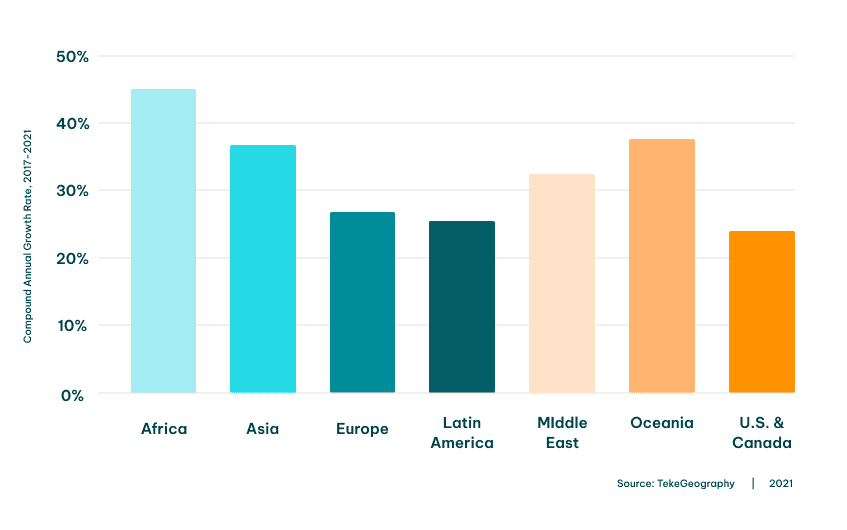
Radio waves can only transmit data up to a limited capacity. On congested 4G LTE networks, users must share limited bandwidth, which slows everyone down.
5G networks solve the issue by utilizing much wider frequency bands to provide greater capacity. This extra room prevents major slowdowns even when thousands of devices connect simultaneously.
Latency
Latency measures how fast a network responds to a request. The average latency of 4G connections is around 30 to 50 milliseconds, whereas 5G offers substantially lower latency and targets a 1 millisecond delay for specialized uses.
This reduction in response time is highly impactful for online gaming, augmented reality applications, remote medical procedures, and autonomous vehicles. It does not, however, make a difference for basic text-based tasks like messaging or using standard website chatbots.
Reach
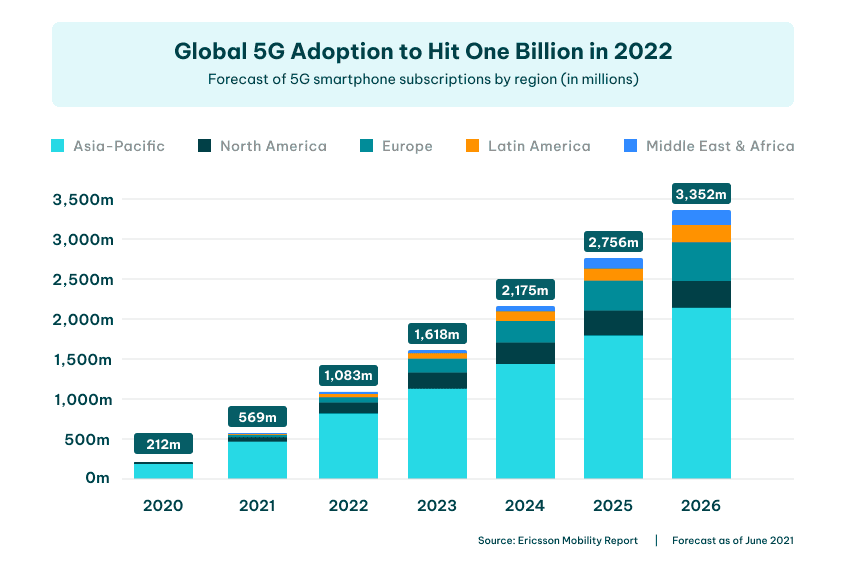
People start using new mobile networks as soon as providers upgrade their local towers, often not even realizing it since everything happens automatically. The June 2026 Ericsson Mobility Report shows global 5G subscriptions passed 3 billion in the first quarter of the year.
The shift is happening much faster than previous mobile network upgrades because modern phones make the transition effortless for consumers.
Devices
You no longer need to go out of your way to join the 5G connection. While it used to be more difficult when it first came out, today, practically every new smartphone includes 5G by default.
Your device simply uses the best available network automatically, as 5G is backward compatible, falling back on 4G only when you travel outside modern coverage zones.
Innovation

The true advantage of 5G goes beyond basic speed. It enables entirely new technologies that require lower latency and reliable connections, such as virtual reality, augmented reality, and autonomous vehicles. With more than 3 billion 5G subscriptions worldwide, developers are constantly building tools that rely on its massive bandwidth.
In healthcare, 5G allows specialists to monitor patient vitals with real-time data and assist in remote procedures. In manufacturing, it powers wireless robotics and coordinates automated assembly lines using real-time data without the need for complex physical cabling.
However, 5G is not a magic solution for every industry. It does not directly improve standard cloud services or basic employee productivity tools, since those run perfectly fine on older networks or standard Wi-Fi. Instead, 5G shines exactly where constant, high-capacity mobile data transfer is critical.
LTE vs. 5G: What Your Network Icon Means
The network symbols in the corner of your phone screen can be confusing. Your device might show 4G, LTE, 5G, or even carrier-specific labels like 5G UC. Each tag tells you exactly how you are connected. LTE stands for Long-Term Evolution, which originally was a stepping stone to help older 3G networks reach true 4G speeds.
Today, carriers treat 4G and LTE as the same thing. Seeing a 4G LTE badge simply means you have a reliable connection fast enough for daily tasks. On the other hand, icons like 5G UC on T-Mobile, 5G UW on Verizon, or 5G+ on AT&T indicate an ultra-capacity band. These connections deliver much faster speeds as long as you are close to the right tower.
The Disadvantages of 5G
Carriers love to advertise their new 5G networks, but you might still hit dead zones outside major cities since 5G uses a mix of frequencies. Because they operate on higher frequencies, the fastest high-band signals struggle to pass through walls or travel long distances, so your phone might lose its best connection the moment you step indoors.
While early 5G phones drained batteries quickly, modern devices are much more efficient. You also no longer need an expensive flagship phone to get connected, since 5G is a standard feature on most devices today.
Sometimes 5G actually feels slower than older networks, and that happens when network operators pack too many users onto limited low-band frequencies. They do that to claim wide coverage, often for marketing purposes.
When thousands of phones connect to the same tower, the congestion can give you a worse experience than a solid 4G LTE connection.
The Takeaway: Do You Need 5G Mobile Internet?
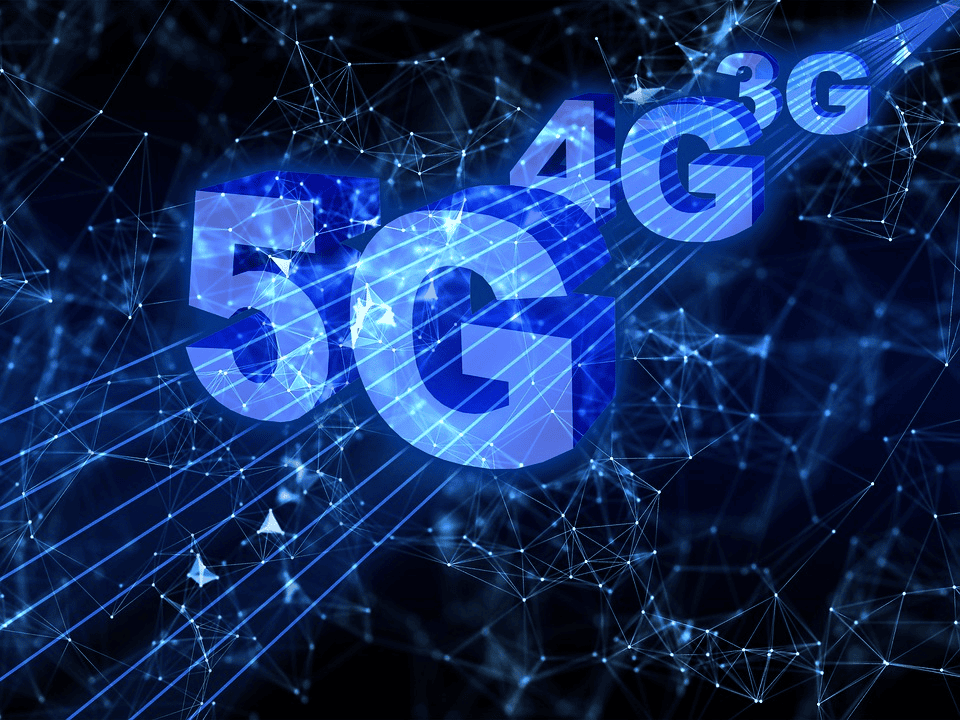
For most people and businesses, 5G is the default standard for modern mobile connectivity. Unless you’re a tech enthusiast, you do not need to go out of your way to make the switch, because any recent phone and data plan already uses it automatically.
While 4G LTE remains a reliable backup when you travel outside the reach of 5G networks, it’s slowly being phased out. If your everyday use only involves sending emails and casual web browsing, you might not even notice the 5G vs. 4G speed difference.
However, if you rely on mobile hotspots, stream high-resolution video, or work remotely with heavy files, having a 5G connection will make a real difference for you.
FAQ
What does LTE stand for?
LTE stands for Long Term Evolution. It was the technical standard that helped older 3G networks transition into true 4G speeds.
Is 5G actually better than 4G?
Yes. 5G provides much faster download speeds and significantly lower latency. It makes demanding apps and mobile gaming run smoothly without lag.
Should I use LTE or 5G?
You should usually leave 5G enabled. Your phone automatically switches between 5G and 4G LTE depending on which signal is stronger, which makes sure you always get the best available connection.
Does 5G drain the battery faster?
Yes. In Ookla’s 2023 analysis, phones on 5G showed 6 to 11 percentage points more battery drain than on 4G LTE. The drain is especially noticeable if your phone is constantly searching for a weak 5G signal. If you need to save battery on a long day, temporarily switching your phone to LTE-only can help.
When will 4G be phased out?
There’s no fixed date. Carriers are gradually moving spectrum from 4G to 5G, but 4G LTE is expected to stay in service for years as a reliable fallback network.