10 Best Rotating Proxy Providers in 2026: Top Services
Software comparisonsCompare the best rotating proxy providers in 2026. Explore features, pricing, and use cases to find the right proxy for web scraping, SEO, and automation.


Milena Popova
Key Takeaways
-
The best rotating proxy service provider depends on what your team is trying to achieve.
-
Compare pricing alongside rotation control, session stability, geo targeting, and scale.
-
A good provider should keep your work running smoothly as the request volume grows.
A rotating proxy server becomes necessary when your team takes on projects that send repeated requests to the same destination from your company’s IP address. Without proxy rotation, you are more likely to get blocked, and the work can slow down or stop.
Even when you understand the need, choosing from the best rotating proxy providers is not easy. Many services look similar on the surface, and that can make it hard to compare your options with confidence. This list brings together the top options so you can review them and make an informed choice.
Top Rotating Proxy Providers in 2026
If you prefer to skip reading reviews, the table below provides a quick overview of the pool size of the best rotating proxy providers.
| Provider | Best For | Rotating Residential Pool |
|---|---|---|
| IPRoyal | Global web scraping at scale | 64M+ |
| MarsProxies | Budget flexible sessions | 1M+ |
| Bright Data | Enterprise-scale scraping | 400M+ |
| Oxylabs | Heavy-duty technical workflows | 175M+ |
| Decodo | Strong session control | 115M+ |
| NetNut | High-volume stable rotation | 85M+ |
| Webshare | Easy low-cost deployment | 80M+ |
| SOAX | Flexible rotation control | 155M+ |
| Rayobyte | Low-cost ethical sourcing | 40M+ |
| Proxywing | Custom sessions at scale | 64M+ |
IPRoyal
If you need global coverage, flexible rotation, and simple pricing models, IPRoyal is the right choice. You can keep the same IP from 1 second up to 7 days, or switch to random rotation when you need a fresh IP more often.
Our rotating proxy service gives you access to 64M+ residential IPs across 195+ locations, which is more than enough for most web scraping workflows and day-to-day proxy tasks. You can also use country, state, city, and ISP targeting, giving your team more control when location accuracy matters. The non-expiring traffic model adds flexibility, since you only buy bandwidth when you actually need it.
Pros
- Strong value if you want rotating proxies without a high entry cost
- Non-expiring traffic gives you more buying flexibility
- Built-in rotation control supports sticky sessions and randomization
- Custom geotargeting lets you choose locations at the country, state, and city level
Cons
- You get a smaller proxy pool than you would with some larger providers
Pricing: Starts from $7/GB for residential proxies
IP pool: 64M+ rotating residential IPs across 195+ locations
Uptime: 99.9%
MarsProxies
MarsProxies offers rotating residential proxies and mobile proxies at an affordable price. Static options include ISP, sneaker, and datacenter proxies. It pairs that with an easy setup process and useful rotation options, which makes it a practical choice when you want coverage without adding friction.
You get flexible IP rotation, including the option to keep the same IP for as little as 1 second or as long as 7 days. You can target more than 190 countries at the state and city level. You also get multi-protocol support, dual authentication, and unlimited concurrent sessions.
Pros
- Access to all your proxies in one place
- Customizable sticky sessions give you more flexibility during session-based work
- Unlimited concurrent sessions support heavier ongoing tasks
- The setup stays simple with multi-protocol support and dual authentication
Cons
- The residential proxy pool is smaller than what some larger competitors offer
Pricing: Starts from $4.99/GB
IP pool: 1M+ IPs across 190 locations
Uptime: 99.9%
Bright Data
Bright Data offers a large network of more than 400 million rotating residential IPs, 1.3 million datacenter proxies, and more than 7 million mobile proxies, which gives you room to scale and rotate without much limitation.
You can target locations with high precision, including country, city, state, ZIP code, and ASN. The platform also supports sticky sessions and more advanced rotation control for session handling, DNS resolution, and request routing. These extra capabilities make it one of the more expensive options here.
Pros
- Very large residential proxy pool
- Precise geo-targeting and session control
- Advanced rotation settings for more technical use cases
- Broad proxy ecosystem with added tools
Cons
- Higher pricing than many alternatives
Pricing: Pay as you go starts from $8/GB
IP pool: 400M+ residential IPs from 195 countries
Uptime: Up to 99.95%
Oxylabs
Oxylabs provides solutions for heavy workloads and more complex proxy tasks without switching platforms. Built for enterprise-scale data workflows, the service puts proxy performance and traffic control on the same level as raw IP volume.
With more than 175 million rotating residential IPs worldwide, Oxylabs supports per-request rotation, sticky sessions for up to 10 minutes, and detailed location targeting at the country, city, state, continent, ZIP/postal code, coordinates, and ASN levels. Its bandwidth-based pricing model offers flexibility, letting you choose monthly traffic plans or pay-as-you-go access based on your needs.
Pros
- Unlimited concurrent sessions support high-volume work
- Access to residential, mobile, and datacenter proxies in one service
- Strong filtering options give you more control over traffic behavior
- Works well for teams with larger technical setups
Cons
- Costs more than many other providers on this list
Pricing: Starts from $30/month for 5GB of rotating residential proxy traffic
IP pool: 175M+ rotating residential IPs
Uptime: 99.95%
Decodo
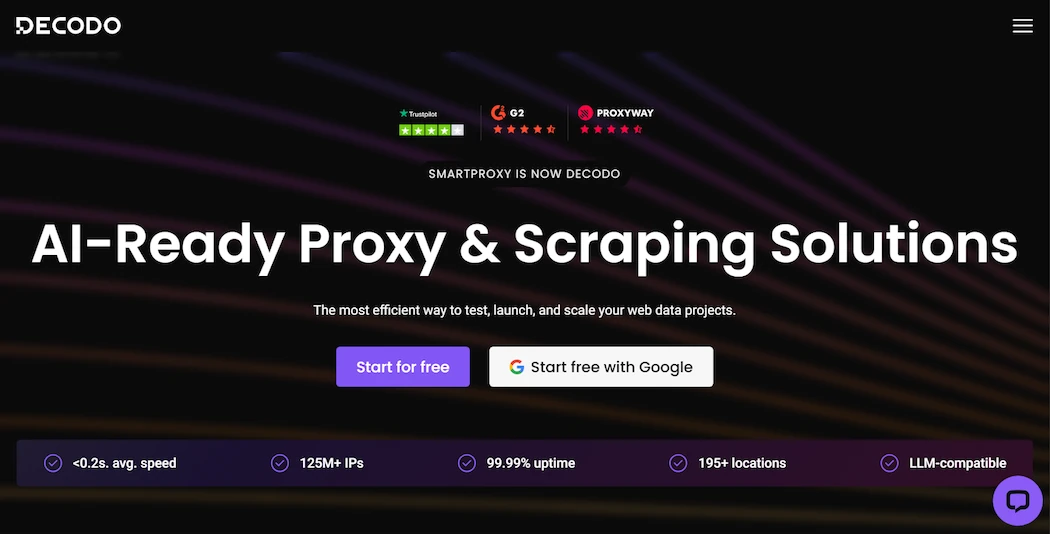
Decodo, formerly known as Smartproxy, helps you rotate per request for tasks that change frequently, or keep the same IP for up to 24 hours when session stability matters more.
Beyond that, the service offers a practical range for enterprise work. Decodo supports unlimited concurrency and lets you target more than 195 countries at the state/region, city, ZIP/postcode, and ASN/ISP level.
If you want to see how IPRoyal compares to Decodo, read our comparison here .
Pros
- Strong rotation options give you more control over session behavior
- Long sticky sessions support workflows that cannot tolerate abrupt IP changes
- Unlimited concurrency helps when proxy use scales across projects
- Broad location coverage makes regional testing easier
Cons
- Casual users may find the feature set more advanced than they need
Pricing: Pay as you go starts from $4/GB, and the monthly plans start from $11.25
IP pool: 115M+ IPs across 195+ locations
Uptime: 99.86%
NetNut
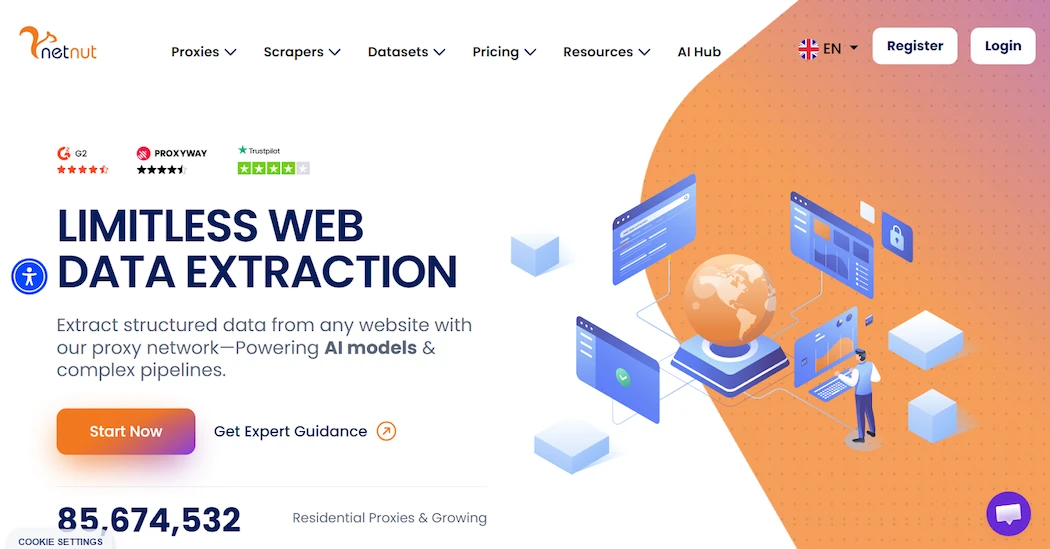
NetNut is a strong fit for high-volume workloads. Its residential backconnect network can assign a new IP to each request, reducing the manual effort that often comes with managing large rotating proxy setups.
When your workflow needs continuity, you can keep the same IP for up to 1 hour or until the session ends. NetNut also supports location-based endpoint generation and targeting across 195+ countries, with city- and state-level options.
Pros
- Request-by-request rotation runs through a stable backconnect gateway
- Numeric session ID control helps preserve continuity during time-intensive tasks
- Endpoint Generator makes targeted setup faster and easier
- Unlimited concurrency and 24/7 IP availability support heavier parallel workloads
Cons
- The minimum monthly commitment can make NetNut harder to justify if your team does not need sustained, high-volume proxy use
Pricing: Starts from $99/month
IP pool: 85M+ residential IPs across 195+ countries
Uptime: 99.9%
Webshare
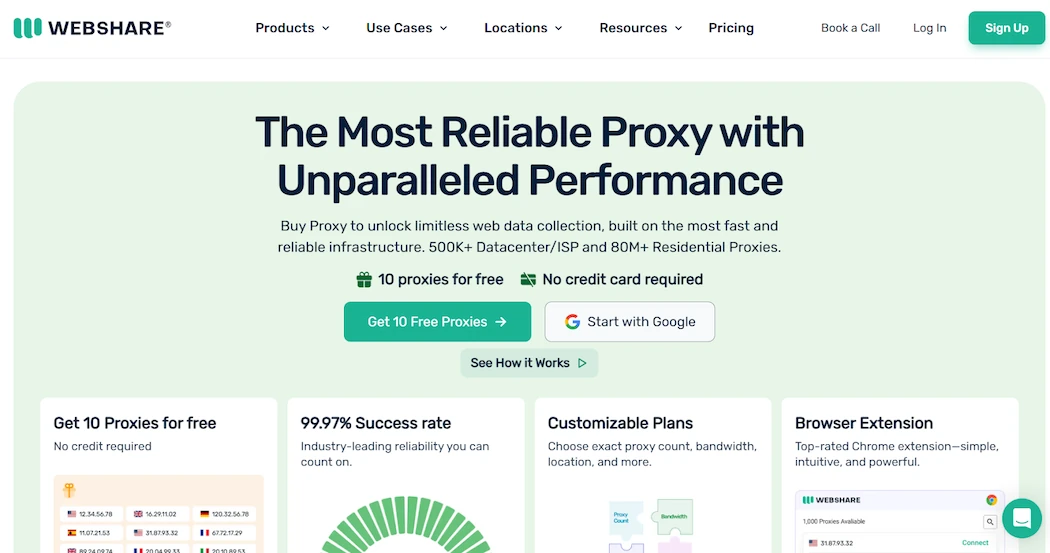
Webshare offers rotating proxies that are easy to deploy and manage once your traffic starts moving. You can choose a faster direct connection, use a rotating endpoint that automatically rotates IPs, or rely on Backbone routing for continuity without changing the address your tools connect to.
You can schedule recurring replacements, increase concurrency for heavier workloads, and split usage across sub-users with separate limits and credentials. These rotation features make Webshare easy to manage across teams or parallel workflows.
Pros
- Connection modes let you choose speed, rotation, or continuity based on the workflow
- Rotating the endpoint reduces manual proxy list handling during active operations
- Sub-user controls help you segment bandwidth, credentials, and access by project
- High concurrency and high-priority network features support heavier usage
Cons
- You may need to watch concurrency limits closely before moving into heavier workloads
Pricing: Starts from $7/month
IP pool: 80M+ residential IPs
Uptime: 99.97%
SOAX
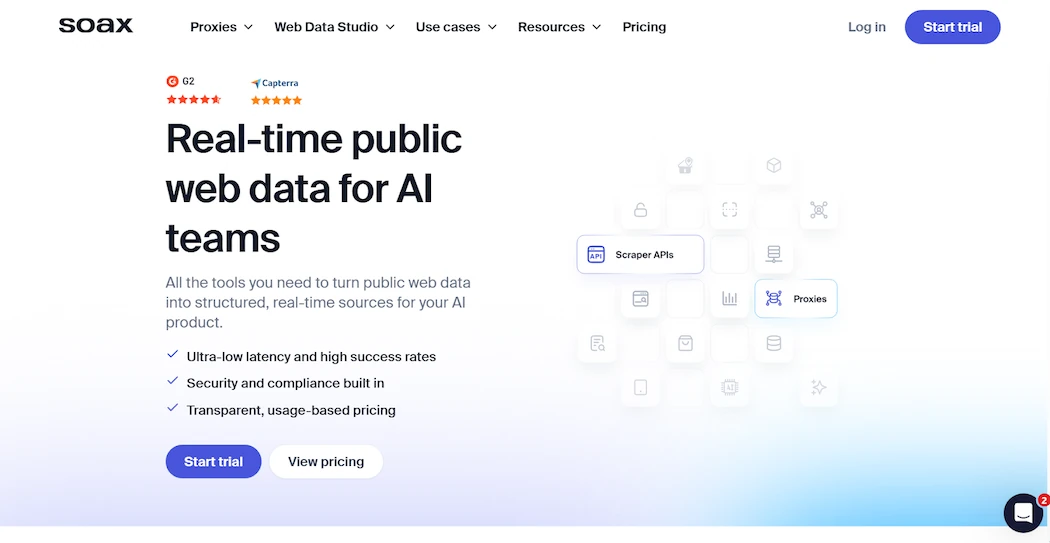
SOAX offers an easy-to-manage unified pricing plan along with custom rotation features. You can choose request-by-request rotation, hold the same IP for up to 24 hours with sticky sessions, or keep it longer through extended same-IP session modes while the node remains online.
It also gives you extra control once the session starts. The web browser parameter is designed to improve browsing stability, and the lookalike parameter helps IP changes feel more natural. These features make SOAX useful when your workflow depends on consistent session behavior.
Pros
- Flexible rotation options give you more useful session control
- Same IP modes help when continuity matters more than frequent switching
- Advanced parameters help browsing and rotation behave more consistently
- Unified pricing can simplify the buying process for larger teams
Cons
- The pricing bundle may feel broader than you need for casual use
Pricing: Starts from $90/month
IP pool: 155M+ residential IPs across 195+ locations
Uptime: 99.95%
Rayobyte
Rayobyte gives you a more affordable entry point to rotating proxies, especially if your team values predictable pricing and simpler setup. The tradeoff is that proxy rotation occurs in fixed 10-minute intervals, so you get less control than with a provider that offers custom rotation options.
This approach will not suit every workflow, but Rayobyte still gives you practical controls where they count. You can target traffic by country, state, or city, and sticky sessions let you keep the same IP for up to 60 minutes when a task depends on session continuity.
Pros
- Affordable pricing lowers the barrier to entry
- Geo-targeting helps with regional scraping and testing
- Same-IP sessions support workflows that need continuity
- Ethical sourcing is a visible part of the product positioning
Cons
- Fixed rotation intervals can be limiting when your team needs more precise control
Pricing: Starts from $3.50/GB
IP pool: 40M+ residential IPs
Uptime: 99.99%
Proxywing
Proxywing offers a flexible, affordable pricing plan matched to customizable rotating proxies. A single proxy list can include up to 100,000 ports, each port mapped to a different IP address. This gives you more room to run parallel tasks without concentrating traffic too heavily.
It also gives you useful control once the session starts. You can set custom session durations between 1 second and 7 days, then combine that with country, region, or city targeting when your workflow depends on both location and session stability.
Pros
- Up to 100,000 ports per list make parallel request handling easier
- Customizable session duration gives you more useful rotation control
- Country, region, and city targeting support localized data collection
- Flexible pricing can work for teams with changing usage levels
Cons
- The setup may feel more complex if your team wants a simpler plug-and-play service
Pricing: Starts from $2.5/GB (standard), $6/GB (premium)
IP pool: 64M+ IPs across 180 locations
Uptime: 99.9%
How to Choose the Best Rotating Proxy Service Provider
The best rotating proxy server is not always the one with the biggest pool or the lowest starting price. A better way to compare services is to ask whether the provider aligns with how your team handles requests, sessions, deployments, and scaling in real workflows.
Here is how to choose the best rotating proxy service provider in 2026:
- Understand the provider’s rotation model
Before you compare anything else, find out how the proxy server provider rotates IPs. Some services automatically rotate on every request, some change IPs at fixed intervals, and some offer flexible rotation options with sticky sessions. That difference matters because each model supports a different kind of work.
- Make sure session continuity fits the task
Some tasks often need a fresh IP. Others fail if the IP changes too soon. If your workflow depends on login persistence, pagination, or multi-step browsing, look for a provider that gives you clear control over rotating sessions.
- Pay attention to deployment and day-to-day management
A service may have large proxy server pools and still be frustrating to operate. Check whether the provider gives your team a manageable way to deploy endpoints, handle credentials, set controls, and monitor usage.
- Think about scale before you need it
When more than one tool or team member starts using the service, concurrency limits, poor traffic distribution, and weak session controls can slow everything down. Choose a rotating proxy service that can handle parallel workloads without strain.
- Check how precise the geo-targeting really is
If location matters, check whether the provider supports country, region, city, ZIP code, or carrier targeting. Strong geo-targeting is often more useful than raw pool size when the workflow depends on location accuracy.
- Look beyond the headline price
Some teams benefit from monthly subscriptions, others need pay-as-you-go traffic, and some prefer non-expiring bandwidth for burst projects. Compare how the billing model works over time, not just the advertised starting rate.
A good proxy network provider should support your workflow without forcing your team to adapt around the service. When you compare rotation behavior, continuity, deployment, scale, targeting, and pricing, it becomes much easier to choose a provider that will keep working after the first test run.
Common Mistakes to Avoid When Choosing a Rotating Proxy Server
The wrong rotating proxy service can cost your team time, money, and operational stability. Here is what to avoid:
- Buying a provider before mapping the workflow
This is one of the most common mistakes teams make. They compare the best rotating proxy providers first, choose one, then try to force it into the project. A better approach is to map the workflow first, then match the provider to the task.
- Treating every request as if it should rotate
More rotation is not always better. Some tasks benefit from request-by-request rotation, while others break when the same IP changes too quickly. If your workflow depends on continuity, aggressive proxy rotation can create problems instead of solving them.
- Confusing a large proxy pool with practical capacity
A provider can advertise millions of IPs and still perform poorly under real-world usage. Inconsistent session handling, sub-par endpoint management, or limited concurrency support can hurt the workflow long before the size of the proxy network becomes useful.
- Assuming the most advanced provider is automatically the best one
A feature-rich provider can look impressive in a comparison and still be the wrong fit for your team. More controls, advanced configuration, and bundled tools often add cost and complexity.
It is also important to understand which type of proxy server you are using, because not all rotating proxies work the same way.
Rotating residential proxies are often the best fit when trust matters, since they route traffic through real user IPs on real residential networks. The tradeoff is that they can be less stable than rotating datacenter proxies, which usually offer higher speed and reliability.
Datacenter proxies, however, are also easier for many websites to detect and block. Rotating mobile proxies use IPs from mobile carriers, which can be especially useful when you need traffic to appear as if it is coming from mobile devices.
Pros and Cons of Rotating Proxies
Pros of Rotating Proxies
- Lower risk of blocks and rate limits when request volume rises
When your team sends many requests from one company IP, sites can start limiting or flagging that traffic. Rotating proxies spread requests across different IPs, which makes sustained high-volume operations easier to keep running.
- More control over session behavior
Some providers support per-request rotation, some use fixed intervals, and others offer same-IP sessions. That flexibility matters because one workflow may need a fresh IP often, while another needs the same IP for longer.
- More accurate location-based work
A good rotating proxy service can do more than change IPs. Many providers let you target by country, region, city, ZIP code, carrier, or ASN, which helps with localized SEO checks, pricing research, and ad verification.
- Support for web scraping and continuity-sensitive tasks
Rotating proxies are not only suitable for aggressive data collection. With the right rotating and sticky sessions, they can also support pagination, account actions, and other workflows that need the same IP to stay in place.
- Reduced manual proxy management
Some providers offer backconnect gateways, rotating endpoints, recurring replacements, or session headers. Features like these reduce the need to manually reshuffle proxy lists, making the rotating proxy service easier to operate day to day.
Cons of Rotating Proxies
- Aggressive rotation can disrupt session-based workflows
If the IP changes too often during login flows, checkout steps, or other session-based tasks, the workflow may fail. Rotation only helps when the timing matches how your team actually needs the session to behave.
- Not all rotation models fit the same kind of work
Some providers rotate per request. Others use fixed intervals. Others rely on same-IP sessions. If your team chooses the wrong model, the rotating proxy service can create friction instead of supporting the workflow.
- Costs can rise fast when pricing does not match usage
A provider may charge per GB, per IP, by monthly commitment, or through bundled plans. If your team buys in bursts or has uneven usage patterns, the pricing model can become inefficient over time.
Rotating vs Static Proxies
The table below explains how use cases vary between static vs rotating proxies :
| Proxy Type | Use Case | Costs |
|---|---|---|
| Rotating proxies | Better for web scraping, price monitoring, ad verification, SEO tracking, and other tasks that send many requests and need regular IP rotation to lower the chance of blocks. | Often billed by bandwidth or usage. Costs can rise faster when traffic volume grows, but the added flexibility can make them worth it for larger-scale operations. |
| Static proxies | Better for account management, login-based tasks, session persistence, and workflows that need the same IP to stay stable for longer periods. | Often easier to predict because pricing is commonly tied to a set number of IPs or a monthly plan. They can be more cost-effective for steady, lower-volume tasks. |
Rotating Proxy Use Cases
While use cases depend on your business, some are common across teams that send repeated requests and need more steady access. Here are three of the most practical use cases for rotating residential proxies.
- Web scraping
Web scraping is one of the clearest use cases because repeated requests to the same site can trigger blocks, rate limits, or CAPTCHA checks. Rotating proxies spread that traffic across different IPs, which helps your team keep data collection moving. Rotating proxies with Python is often the most reliable way to access public data, thanks to Python’s robust web scraping libraries.
- SEO and SERP tracking
Search engines often localize results and can respond differently when requests come from a repeated source. Rotating proxies makes SEO tracking more stable and helps your team check rankings from different locations with more realistic visibility.
- Ad verification
Online ads are often served differently based on location, device, user profile, and other factors. If a large number of checks come from one IP, blocks can happen quickly. Rotating proxies helps distribute requests better, helping ensure correct placement, accurate targeting, and protecting against fraud.
FAQ
Do I need rotating or static proxies?
Choose rotating proxies when you need to send many requests to the same site and want to reduce blocks. Choose static proxies when your workflow depends on keeping the same IP for longer, especially for logins, account actions, or other session-sensitive tasks.
Are rotating proxies better than static proxies?
Not always. Rotating proxies are better for high-volume work, scraping, and location-based checks. Static proxies are better when stability matters more than frequent IP changes. The better option depends on what your workflow needs most.
How frequently should I rotate proxies?
Rotate as often as the task requires, not as often as possible. Some workflows work well with per-request rotation, while others need slower changes or same-IP sessions. If the IP changes too often, session-based work can break.
What is a sticky session in rotating proxies?
A sticky session lets you keep the same IP address for a set period rather than changing it on every request. That helps when your workflow needs continuity, such as staying logged in, moving through pagination, or completing multi-step actions.
How much do rotating proxies cost?
That depends on the provider and pricing model. Some charge per GB, some by monthly plan, and others use bundled or minimum-commitment pricing. The real cost depends on how much traffic your team uses and how the service fits your workflow.