5 Best AI Web Scraping Tools Compared for 2026
Software comparisonsExplore the best AI web scraping tools for seamless data extraction. Compare options and learn how to pick the best one for you.

Justas Palekas
Key Takeaways
-
Choosing the right software depends heavily on your technical expertise and the scale of your operations.
-
AI simplifies locating elements and adapting to layout changes, but it doesn't solve network blocking on its own.
-
Pairing modern extraction logic with anti-bot infrastructure, such as premium residential proxies or dedicated web unblockers, is mandatory for reliable, uninterrupted enterprise-level access.
AI web scraping tools are applications built to automate the heavy lifting of gathering online information, often using machine learning models to dynamically generate, self-heal, or even entirely bypass the need for manual CSS selectors.
Some of these web scraping tools focus on making the setup process effortless for non-technical users, while others provide infrastructure for developers handling massive operations involving complex sites and aggressive anti-bot measures.
We’ll look at the top contenders in the market right now to help you figure out which AI web scraper aligns with your specific needs. Relying on outdated web scraping tools just doesn’t cut it anymore when you need a reliable web scraper to run quietly in the background.
What Is an AI Web Scraping Tool?
AI web scraping tools use machine learning to understand page content semantically and, in the case of vision-based models, visually, rather than relying strictly on the underlying code structure. Traditional scrapers, on the other hand, rely on hardcoded rules that break the second a site updates its layout.
Injecting artificial intelligence into web scraping means the software adapts to minor structural shifts and figures out where the target elements live without you having to write complex XPath sections or regular expressions. The real advantage shows up during the initial setup phase, where models parse the HTML and automatically classify fields for immediate web data extraction.
They also clean up the output and adapt on the fly when the target page changes. Using modern AI scraping tools significantly reduces the maintenance burden, making any web scraper far more resilient over time.
How We Evaluated the Best AI Web Scraping Tools
When you need to extract data reliably, the tool you choose has to tick several crucial boxes across performance and usability. We evaluated the top AI web scraping tools based on:
- Ease of use. How intuitive the interface feels for beginners.
- AI capabilities. The depth of capabilities offered for advanced users who conduct rigorous data collection.
- JavaScript rendering. Rendering modern frameworks seamlessly is mandatory since almost everything relies on heavy frontend logic now.
- Anti-bot handling. Overcoming CAPTCHA and sophisticated blocking algorithms separates a reliable AI web scraper from a frustrating one.
- Output quality and integrations. The cleanliness of the exported data, whether structured for databases or clean markdown for LLM ingestion, matters just as much as the integrations available to pipe that information into your existing systems.
- Pricing, scalability, and compatibility. How well the platform scales under load, and whether it natively manages complex proxy rotation for you or seamlessly integrates with your own external proxy networks.
Every good web scraper needs to handle these challenges natively. Since it needs to check quite a lot of boxes, finding the perfect web scraper for your needs takes time. Rather than building an AI web scraper from scratch, relying on existing platforms saves months of engineering.
The Best AI Web Scraping Tools
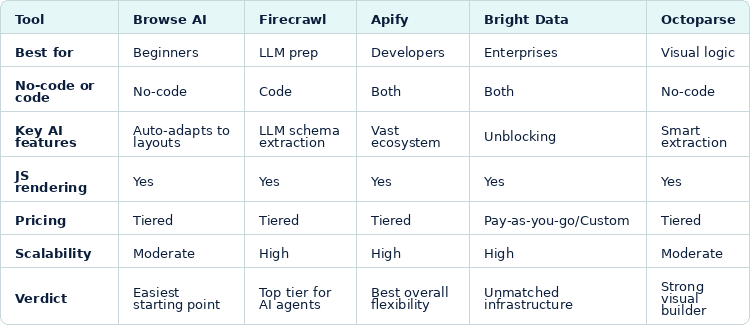
Here are the best AI web scraping tools out there as of 2026:
1. Browse AI
A platform built primarily for non-technical users who want to monitor pages without writing scripts. You just point and click, and the AI web scraper figures out the repeating patterns automatically.
Best for: Non-technical users and beginners needing basic page monitoring and data collection.
Key features:
- Point-and-click AI training
- Automatic layout pattern recognition
- Pagination handling
- Automated change alerts
Pros and cons: It gets the job done easily for simple setups, but you might find the execution speed slightly slower than raw API calls.
Pricing:
- Free plan available
- Paid plans start from $19/month (billed annually) or $48/month (billed monthly)
2. Firecrawl
Engineers feeding information into large language models usually gravitate toward Firecrawl. It takes chaotic HTML and strips it down into clean markdown, making it a highly specialized web scraper for modern AI development workflows.
Best for: Developers and AI engineers who need to scrape websites efficiently for LLM ingestion.
Key features:
- Direct HTML-to-markdown conversion
- LLM-based structured data extraction
- Rapid domain traversal
- API-first architecture
Pros and cons: It excels at traversing entire domains quickly to extract data, though it lacks a visual builder for those who prefer point-and-click interfaces.
Pricing:
- Free plan available
- Paid plans start from $16/month (billed annually) or $19/month (billed monthly)
3. Apify
As a comprehensive web scraping platform, Apify hosts thousands of pre-built actors for targeting specific sites. Developers write JavaScript, TypeScript, or Python to control headless browsers, utilizing integrated proxies to change their IP origin.
Best for: Programmers looking for massive flexibility and ready-to-use scraping templates.
Key features:
- Thousands of pre-built modular actors
- Headless browser control via JavaScript
- Integrated proxy management
Pros and cons: The flexibility is essentially limitless for massive data extraction jobs if you build custom scripts, but even if you don’t know how to code, you can still extract immense value by running thousands of pre-built, ready-to-use scrapers from the Apify Store.
Pricing:
- Free plan available
- Paid plans start from $26/month (billed annually) or $29/month (billed monthly)
4. Bright Data
Organizations running massive operations generally end up here because the underlying infrastructure is incredibly resilient. The platform combines a powerful AI web scraper with an enormous proxy network to bypass almost any restriction.
Best for: Enterprise-level organizations running massive, resource-intensive scraping operations.
Key features:
- Automated unblocking
- Complex session management
- Integration with a massive global proxy network
Pros and cons: You won’t find a more capable web scraper for bypassing restrictions to pull web data quietly in the background. The major downside is that it requires a substantial budget.
Pricing:
- Free trial available
- Pay-as-you-go plan available
- Scale plan starts from $499/month
5. Octoparse
People who prefer visual workflows often choose this desktop application to set up their routines. The web scraper features a smart algorithm that automatically detects complex data structures, repeating patterns, and pagination on the page to jumpstart your workflow.
Best for: Users who prefer visual desktop applications to construct their scraping logic without touching a command line.
Key features:
- Smart algorithm for auto-detecting tables/lists
- Visual navigation path builder
- Local desktop builder with scalable cloud-based execution
Pros and cons: It makes setting up complex routines visually straightforward, but it sometimes chokes on highly customized single-page applications.
Pricing:
- Free plan available
- Paid plans start from $69/month (billed annually) or $83/month (billed monthly)
What Features Matter Most in an AI Web Scraping Tool?
It can be easy to get lost in all the features, so it’s important that you understand how to single out the most important ones.
JavaScript Rendering and Dynamic Content Support
You have to ensure your chosen application can actually execute frontend code before pulling the HTML. Most modern sites load empty shells and populate the interface through API calls after the initial request. If your tools fail to wait for this dynamic content to appear, you end up extracting blank fields.
While reliable JavaScript rendering is essential for interacting with complex frontends, the most efficient AI tools also allow you to intercept the underlying network API calls directly, grabbing the raw data payloads without wasting resources rendering the DOM. Setting up tools designed to handle dynamic content also prevents broken pipelines.
Anti-Bot Handling and Reliability
Target servers actively try to prevent automated systems from pulling their information, which means a capable AI web scraper needs to solve CAPTCHAs, manage fingerprinting, and mimic human interaction patterns automatically.
If the software can’t bypass Cloudflare or Datadome, your data extraction pipeline breaks immediately. Setting up data extraction pipelines without unblocking tools is basically a waste of time.
Proxy Rotation and Geo-Targeting
Masking your origin IP prevents the target server from blocking your entire operation after a few requests. Using high-quality rotating proxies ensures you look like a different user every time you attempt to extract data.
Accessing region-locked content requires routing your traffic through specific geographic locations to retrieve localized web data. While highly protected targets require premium residential or mobile proxies , you can optimize costs by routing traffic using fast, cheap datacenter proxies by default and only swapping to expensive residential IPs when a block is detected.
Cost, Integrations, and Scalability
Moving thousands of records manually isn’t practical when running automated systems. You need seamless API access and dedicated webhook integrations to automatically pipe the extracted data directly into your databases or cloud storage the moment a job finishes. The pricing model also needs to support your growth without punishing you for scaling your AI web scraping volume.
Do You Still Need Proxies for AI Web Scraping?
The short answer in most cases is yes. But let’s see why that is, and in what situations built-in scraping infrastructure may be enough.
Why AI Scrapers Still Get Blocked
No matter how smart the underlying model is at parsing the DOM, the target server still sees the incoming network request. If a thousand requests hit the server from a single datacenter IP, or if your TLS fingerprints and HTTP headers scream “bot”, modern security systems will instantly drop the connection.
Artificial intelligence helps you interpret the page, but it doesn’t hide your network identity during data collection. Relying solely on web scraping tools without proxies guarantees failure at scale.
When the Built-in Scraping Infrastructure Is Enough
A few premium web scraping tools handle the network layer entirely on their end. They route your requests through their own proprietary unblocking systems, so you don’t have to manage the proxy pools yourself.
This works perfectly fine for users who want a plug-and-play solution, as well as enterprise teams who prefer paying a premium for fully managed infrastructure rather than maintaining their own complex proxy logic in-house.
When Residential Proxies Make More Sense
Operating at a massive scale often requires decoupling your extraction logic from your network routing to control costs. Routing your custom web scraper through a premium residential proxy network like IPRoyal guarantees you get authentic IP addresses from actual household devices.
Our service is based on a pay-as-you-go model, with your traffic never expiring. This approach yields the highest possible network trust scores, and when paired with a stealthy headless browser, it effectively prevents the target from detecting your AI web scraping activities.
Global Pool, Precise Targeting, Zero Contracts
Premium Residential Proxies
Is AI Web Scraping Legal?
While extracting publicly available information is generally legal from an access standpoint, you must still navigate complex copyright laws and strict data privacy regulations (like GDPR and CCPA) regarding the actual content you collect. Furthermore, extracting data hidden behind a login or explicitly bypassing a site’s Terms of Service transitions from simple data extraction into a potential breach of contract.
Overwhelming a server with requests to the point of degrading their service crosses a line. Sticking to public data and actively throttling your AI web scraper to mimic normal human traffic helps mitigate the risk of degrading target servers, which is a critical best practice for running responsible and compliant data extraction.
While a properly configured AI web scraper prevents IP bans, you should still consult legal counsel before executing mass data extraction.
Conclusion
Finding the right fit depends largely on your technical background and the volume of pages you need to process. Apify offers the best environment for developers building custom pipelines, while Browse AI dominates for teams and individuals seeking a fast, no-code visual builder to monitor pages.
No matter which AI web scraping tools you deploy, success ultimately hinges on the quality of your underlying network infrastructure. Pairing an advanced web scraper with IPRoyal’s responsibly sourced residential proxies ensures your network requests remain trusted and uninterrupted as you scale up your efforts to extract data.
In short, if you want to extract data successfully, proxies are your best friend.
FAQ
What is the best AI web scraping tool for beginners?
Browse AI stands out because it removes the coding requirement entirely and lets you visually train the robot to execute data extraction. Using visual AI scraping tools saves hours of frustration.
Is there a free AI web scraping tool?
Many web scraping tools offer limited free tiers or trial credits, but purely free options usually lack the power to handle modern anti-bot protections.
How much do AI web scraping tools cost?
Prices for AI web scraping tools vary wildly from $30 a month for basic visual setups to thousands of dollars for enterprise platforms executing massive AI web scraping campaigns.
Can AI web scraping tools handle JavaScript-heavy websites?
Yes, modern AI web scraping tools include headless browsers specifically designed to wait for dynamic content to load before attempting to extract data.
Which AI web scraping tool is best for large-scale scraping?
Platforms like Bright Data and Apify are the top choices for large-scale operations because they provide the massive concurrency and built-in proxy infrastructure necessary to smoothly scrape websites and extract millions of rows of clean, structured data.