Best Amazon Scraper APIs for 2026
Software comparisonsLearn about the best Amazon scraping APIs to choose software for your use case in a carefully selected list of Amazon data extraction tools.


Kazys Toleikis
Key Takeaways
-
It's important to know what success rates, response times, marketplace coverage, product fields, and other details a tool can cover before purchasing.
-
Apify, ZenRows, ScraperAPI, and ScrapingBee offer some of the best Amazon scraper APIs.
-
A good rule of thumb for choosing Amazon data extraction tools is to go with the most flexible options that won't lock you into their ecosystem or proxy pool.
As with many major websites, scraping Amazon data is as beneficial as it is difficult. From simple IP blocks and CAPTCHA challenges to advanced browser fingerprinting, JavaScript rendering requirements, and even honeypot traps - Amazon deploys almost all possible defenses on its product pages.
Building your own data extraction tools, especially an efficient parser, for scraping Amazon is no easy feat, and many turn to Amazon scraping APIs. Most popular Amazon data collection tasks for product research, review analysis, and others can be covered by a well-chosen web scraping API.
How We Evaluated the Best Amazon Scraper APIs
Choosing the right Amazon scraping API requires going past marketing claims and testing what actually matters for data extraction. We evaluated each tool based on five core real-world factors.
- Success rate- the percentage of requests returning complete structured data that can be used for analysis.
- Response time- the time it takes to get from making a request to usable Amazon data in a realistic workflow.
- Structured fields per product- the number of clean, consistently filled product details a web scraping API can generate.
- Geographic coverage- the reliability of Amazon data from multiple marketplaces, not just Amazon.com .
- Effective cost per 1000 requests- the real pricing model costs you’ll need to cover, taking into account failed requests, JavaScript rendering charges, and other factors.
Our benchmark dataset consisted of 300 URLs spread across product detail, review, and search result pages, as well as product and Best Seller categories. The mix of page types was deliberate to find edge cases for all Amazon scraping APIs. Domains tested included amazon.com , amazon.co.uk , amazon.de , and amazon.co.jp to surface regional performance gaps.
Best Amazon Scraper APIs Reviewed
Apify
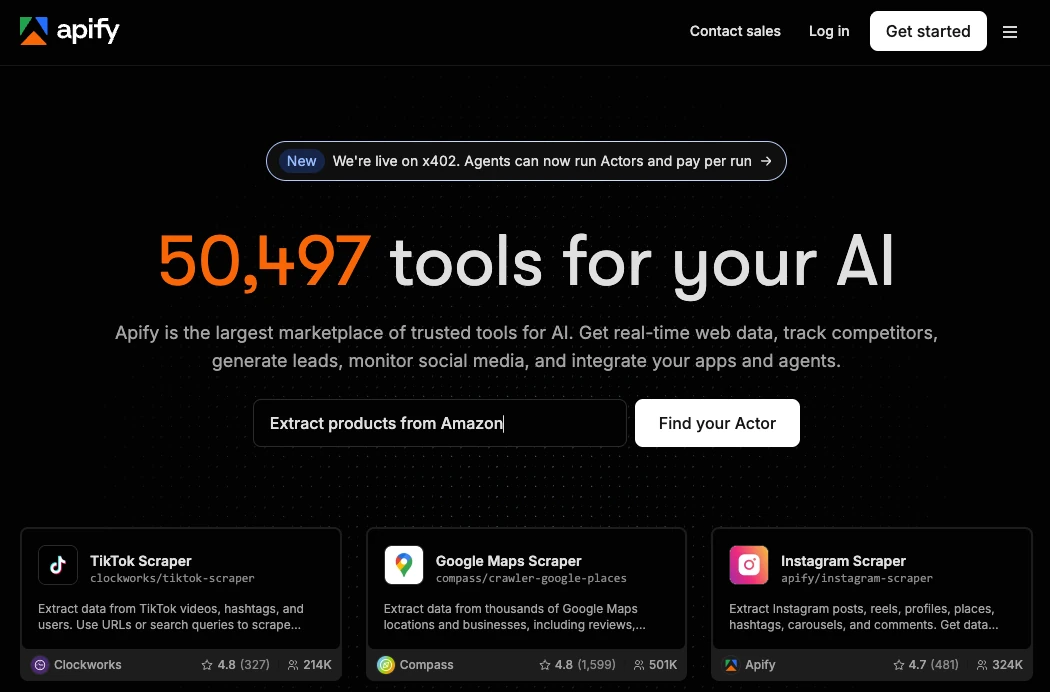
Apify is the best Amazon scraping API for flexibility. It’s an automation platform built around community-driven Actors. The Amazon Product Scraper and Amazon Reviews Scrapers are well-maintained and work out of the box.
If an existing Actor doesn’t suit you, using code examples to build a custom scraper with Apify’s tools is easy. Features like rotating proxies , scheduling, and storage are handled natively. It’s best for teams that need more than a fixed web scraping API subscription.
- Success rate: Varies by Agent, typically in the 94 – 97% range.
- Response time: Our tests show 2 - 4 seconds for rendered pages and 4 - 7 seconds for JavaScript-heavy search result pages.
- Pricing: Free plan. Paid plans start from $29/month with pay-as-you-go for compute units.
Getting the most out of Apify comes with a steep learning curve, which might not be for projects that require only simple endpoint access. Yet, learning to use Apify’s data collection agents is definitely worth it.
ZenRows
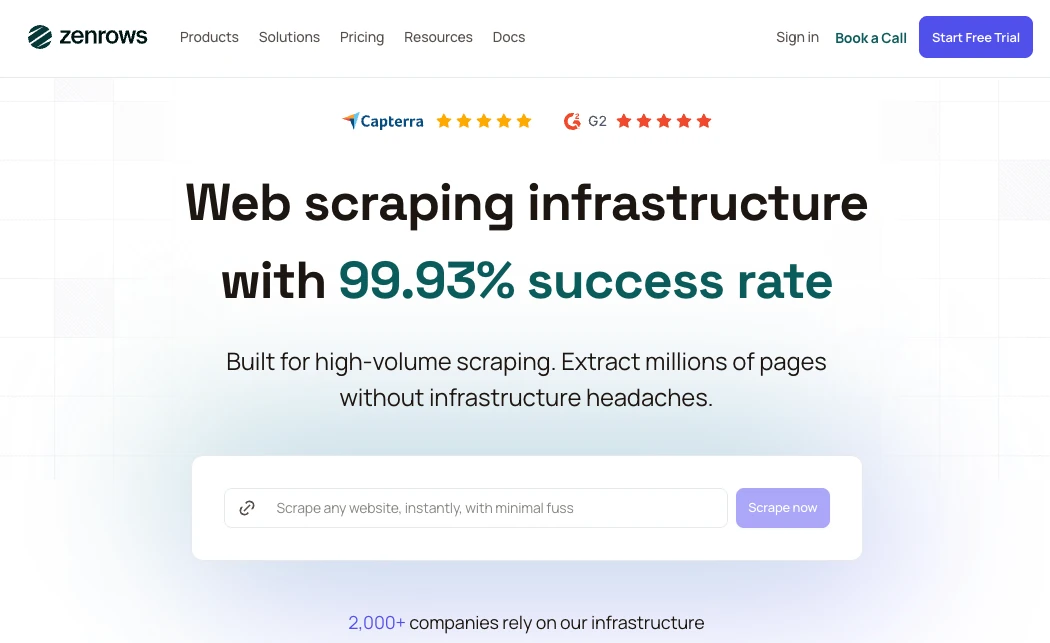
ZenRows offers a developer-friendly web scraping API, with most of what you need to scrape Amazon reviews and product pages covered. A single API endpoint handles JavaScript, proxy management, and CAPTCHA solving with minimal configuration.
The tool also stands out as quite affordable for the number of results you get. Even small teams can purchase ZenRows and extract structured data without committing to expensive plans or complex integrations.
- Success rate: Averages around 97% in our testing.
- Response time: Response times average 2 - 4 seconds for rendered requests, while JavaScript pages faced some large variations.
- Pricing: Free trial. Subscription starts from $69/month for 250,000 API calls.
Teams that need lots of different Amazon product page fields might find ZenRow’s out-of-the-box data extraction limited. For most use cases, however, ZenRow is suitable and quite affordable.
ScraperAPI
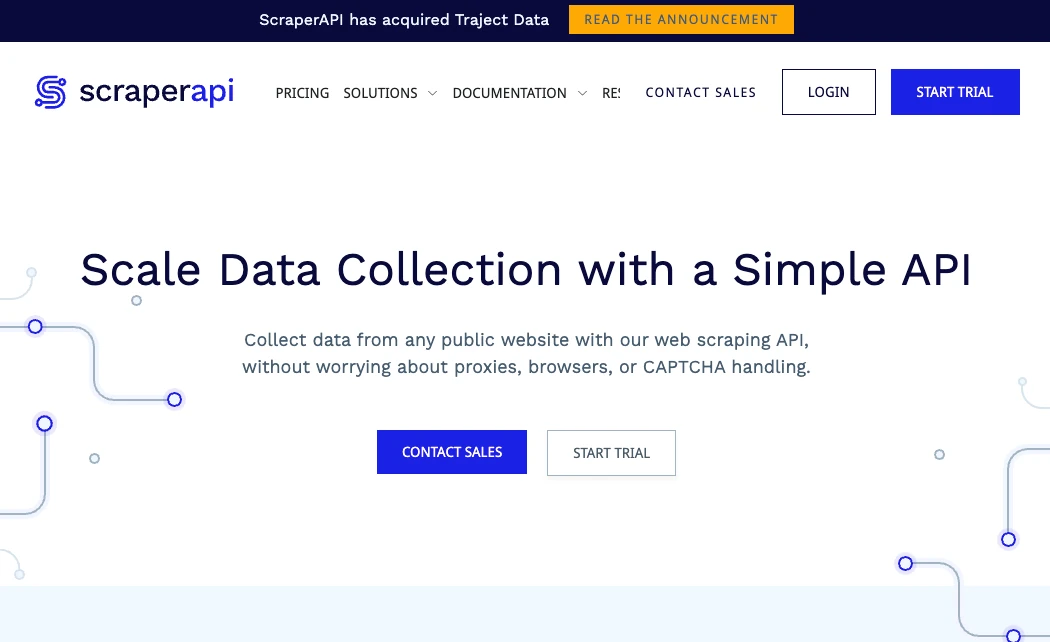
ScraperAPI is a widely used web scraping API that stands out with its accessibility. It handles all the core web scraping infrastructure, such as proxy rotation, JavaScript, or CAPTCHA, behind a single easily configurable endpoint.
Its generous free trial and low pricing make it a great entry point for those who are new to scraping product pages. ScraperAPI is also common in hybrid data pipelines, complementing other tools.
- Success rate: On standard Amazon product pages, success rates average 96%.
- Response time: Average 2 - 4 seconds for rendered pages, struggles with JavaScript-heavy ones.
- Pricing: 7-day trial. Hobby plan starts at $44/month.
ScraperAPI is best for returning raw HTML with limited field depth and success rate, but with some additional engineering for retry logic and parsing, it’s a great foundation for projects.
ScrapingBee
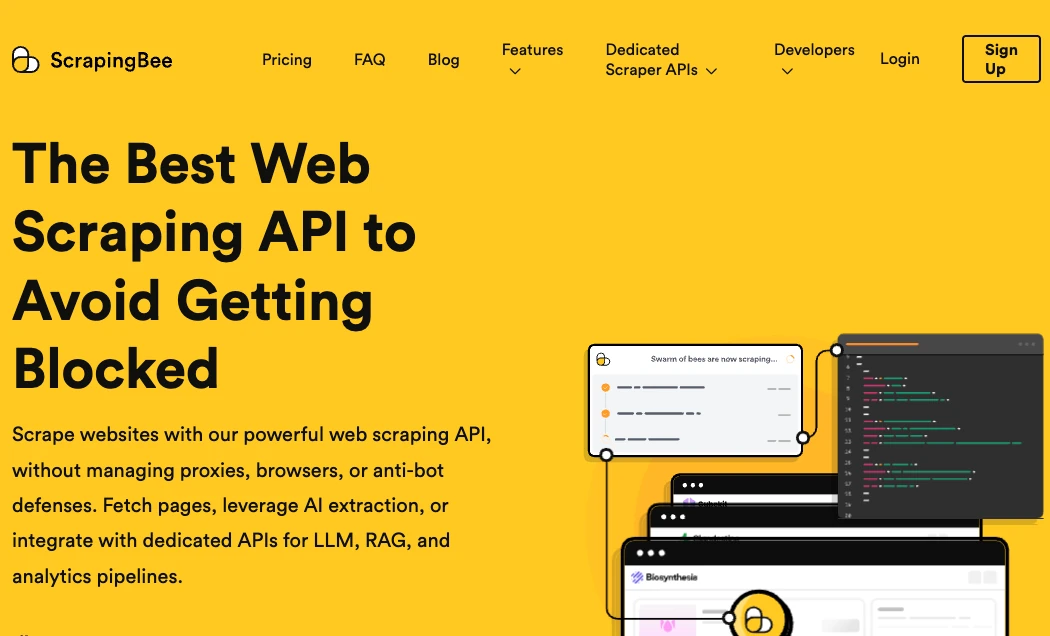
ScrapingBee differentiates from other tools with Amazon product page-specific features. They enable complex parameters to produce a structured JSON output almost effortlessly.
For teams looking to get the first iteration of their data pipeline up and running quickly, ScrapingBee is one of the best options. ScrapingBee stands out for being easy to set up and having well-documented instructions and code snippets.
- Success rate: We found an average of 96% for Amazon product pages.
- Response time: 2 - 5 seconds for JavaScript-rendered requests.
- Pricing: 1000 free API calls trial. Freelance plan starts at $49/month.
Based on our stress testing, success rates, and field depth are the main weak points of ScrapingBee. More straightforward projects at moderate volumes shouldn’t have many issues.
Nimbleway
Nimbleway is a web data gathering platform with strong functions for ecommerce pricing intelligence, including on Amazon. The tool is difficult to compare since Nimbleway differentiates itself by how clean and complete the JSON format datasets are.
For use cases that need rich, consistently structured product data, Nimbleway punches above its weight relative to its popularity. Data teams that prioritize structured data quality and field depth will find this to be the best option.
- Success rate: Success rates on Amazon product pages average 95 - 97%.
- Response time: Around 3 - 5 seconds for rendered requests.
- Pricing: Free trial for 5000 web pages. Pay-as-you-go pricing model.
Teams with high-concurrency requirements for real-time data pipelines, for example, will need to look elsewhere. However, Nimbleway takes the lead for use cases where data quality is most important.
Decodo
Formerly a proxy provider known as Smartproxy, Decodo now focuses on web data collection infrastructure, including e-commerce data extraction, with Amazon as a primary use case. It is rather reliable for structured output without the complexity that comes with more powerful tools.
It’s best for those who already use Decodo proxies and have a one-time project to finish. It might also be a stepping stone if you have outgrown entry-level tools for review and search results pages.
- Success rate: Amazon product pages average 93%.
- Response time: Highly varies between 3 and 8 seconds based on request type.
- Pricing: The lowest-tier plan costs $19 plus proxies based on usage.
Compared to platforms like Apify, Decodo lacks an ecosystem and flexibility, and its affordability suffers from locking customers into its proxy selection.
Zyte API
Zyte (formerly Scrapinghub) is a long-standing scraping API provider, with an ecommerce data extraction API as its core product. For Amazon specifically, Zyte’s automatic extraction mode can parse product pages into structured fields without requiring custom configuration.
It significantly helps with integration in larger data pipelines or analysis tools. Zyte API is well-suited for teams requiring ease of integration while reducing engineering complexity.
- Success rate: Success rates average 93 - 96%.
- Response time: Expect around 3 to 6 seconds.
- Pricing: Plans from $100/month plus a consumption-based pricing model.
While the automatic extraction mode is convenient, it’s less reliable than manually configured data extraction, especially for specific data field requirements. Still, if your project allows and you can afford it, the Zyte API is definitely worth considering.
Bright Data
Bright Data is one of the largest proxy providers, positioning itself as a data extraction platform, with its main product being its scraping API. Their dedicated Amazon Dataset marketplace for pre-collected data and a structured Amazon Scraper API make them worth considering.
It’s best for extremely large enterprises with big data needs and a budget to match. Bright Data upsells its proxies with all tools, which requires a good justification for the expenses you’ll incur.
- Success rate: Around 97% across standard product pages.
- Response time: 2 - 7 seconds for rendered results.
- Pricing: Scale plan from $499/month, pay-as-you-go for $1.5 for 1000 records.
For small to mid-sized teams, Bright Data’s pricing can be difficult to justify when alternatives offer similar performance at a lower cost. Yet, many companies can spare the expenses.
Oxylabs Web Scraper API
Oxlylabs offers a dedicated Web Scraper API with strong Amazon-specific capabilities and a proxy network to match enterprise needs. The quality of their structured data outputs is rather reliable, and they advertise as charging only for successfully delivered results.
The closest comparison is with Bright Data scrapers, standing out with slightly more competitive pricing. Large corporations and enterprise teams will find their reputation and technical support to be an important selling point.
- Success rate: Expect up to 97% on the main Amazon pages.
- Response time: Our tests found responses to take 3 - 7 seconds.
- Pricing: Micro plan costs $0.50 per 1000 results, plus the price of proxies.
Like with most proxy providers offering scraping APIs, Oxylabs suffers from a complicated onboarding process that aggressively upsells its proxies. Teams without dedicated data engineering resources may find the setup expensive and complicated.
How to Choose the Right Amazon Scraper API
Choosing Amazon scraping APIs often comes down to getting the needed functions and switching between them easily. You need to balance data types, proxy strategies ( static vs rotating ), geo-targeting, output fields, and more. No matter the scale or budget, aiming for more flexibility is almost universally recommended.
When it comes to specific functions, you need to consider various factors, and having a checklist for identifying them comes in handy.
- Volume. How many requests per set period (day, month, year) will you realistically need?
- Latency tolerance. Do you need real-time data extraction, or will asynchronous delivery be acceptable?
- Required fields. What Amazon data is non-negotiable? What are only nice to have? Consider fields like prices, reviews, BSR, seller info, images, and evaluate your needs.
- Marketplaces. Is access to Amazon.com only acceptable, or will a multi-region (UK, DE, JP, etc.) approach be necessary?
- Pricing model preference. Considering your planned usage, will pay-per-result, pay-per-request, or a subscription save you the most?
- Amazon proxy compatibility. Some Amazon scraping APIs work best with dedicated Amazon proxies from their brands. Is the reliability and loss of choice suitable for you?
Flexibility is not the only deciding factor. When it comes to specific functions, consider your use case and your team’s size. A small team with limited resources is likely to have fewer Amazon data needs for the same product pages. Mapping your team to a tool type is another great way to decide.
| Usage needs | Recommended Tools | |
|---|---|---|
| Small teams | Limited budget, need simplicity | ScraperAPI, ScrapingBee, Apify |
| Mid-market | Growing Amazon data needs require reliability and support | ZenRows, Zyte API, Apify (custom actors) |
| Deep analytics | High volume, structured output, multi-marketplace | Bright Data, Oxylabs Web Scraper API, Nimbleway, Apify |
| DIY parsing | Prefer raw HTML with proxy control, have in-house dev resources | Rotating residential proxies with Apify (custom actors) |
Common Amazon Data Use Cases in 2026
Amazon scraping APIs, which we covered here, are much more powerful than basic competitor pricing intelligence. The range of applications offered in the market has expanded significantly, and what’s right for you might depend more on your use case than on technical parameters.
- Real-time price monitoring is all about tracking seller prices as they change. Web scraping APIs from Decodo, ScraperAPI, ZenRows, and others offer specific features for handling the volume and speed required for such a task.
- Catalog enrichment takes product details from structured Amazon data at scale to keep internal databases updated. Bright Data, Oxylabs, and Nimbleway are frequently recommended for such tasks.
- Review and sentiment analysis tasks require grouping feedback and ratings across thousands of product pages to find trends. Solutions from Apify and ScrapingBee are advertised as fitting for this use case.
- Best Seller Rank (BSR) tracking involves monitoring a seller’s product ranking position over time to find changes. Tools like ScraperAPI, Decodo, and ZenRows are common for such tasks.
- Seller intelligence helps profile sellers around a particular listing to identify pricing behavior, stock levels, ratings, and other trends. Apify, Nimbleway, and other tools are frequently recommended for seller intelligence tasks.
- AI training data requires high-volume, consistently structured product data for training LLMs. Most tools on our list advertise that they provide such data in some capacity.
Most professional scraping setups use a hybrid approach for the best results. Combining different providers with custom solutions, quality residential proxies, and other tools keeps costs manageable without sacrificing data quality.
Note that whether scraping Amazon data is legal might depend on local laws and your use case. Scraping publicly available data is legal in most jurisdictions, but Amazon’s website forbids it in its terms and conditions, so irresponsible scraping might lead to account bans or other restrictions.
Conclusion
The choice comes down to where your priorities lie in a spectrum between simplicity, Amazon data depth, and costs. Apify leads for teams that value flexibility and platform completeness. Bright Data and Oxylabs tools suit very large corporations best, while the remaining tools serve smaller teams where simplicity and affordability take priority.
FAQ
Is it legal to scrape Amazon with third-party APIs?
It is legal to scrape publicly available data, including Amazon product pages, prices, and reviews, that are not behind a login. Yet, Amazon’s website explicitly prohibits automated data collection, including third-party Amazon scraping APIs, and the legality of data extraction also depends on jurisdiction and where you use the data.
How do these APIs avoid IP blocks and CAPTCHAs on Amazon?
Amazon scraping APIs use large pools of quality residential proxies, rotating them frequently together with realistic browser fingerprints, session cookies, CAPTCHA solvers, and other measures. Most importantly, effective web scraping APIs continually update and adapt their approach as defenses change to continue collecting Amazon data.
Do I need JavaScript rendering for Amazon scraping?
Yes, in most cases, you need JavaScript to collect Amazon web data, as the most important fields, such as shipping price or availability, are presented dynamically. For some static fields, like product titles, you might be able to collect data with a simpler scraper that doesn’t require JavaScript rendering.