Top 6 Best News APIs for 2026: Features, Pricing, and Use Cases
Software comparisonsLearn what news APIs are and how to choose one for your news content project with six examples that fit most news data collection needs.


Kazys Toleikis
Key Takeaways
-
News APIs provide a programmatic way to retrieve news articles, headlines, and other data in a structured format directly into your app without maintaining your own scraper.
-
The main things to look for in an API are search capabilities, a consistent response structure, clear documentation, and advanced features for working with data.
-
Start by defining your use case and what capabilities it actually requires before committing to a lengthy news API subscription.
If you’re determined to choose an API over web scraping for news content, the choice depends more on project needs than any other factor. News story breadth, update latency, licensing terms, and integration are all important, but you must first know your use case.
We’ll break down what separates good news APIs from mediocre ones, identify the crucial features worth comparing, and give six news data APIs that’ll fit most news sources and use cases.
What Is a News API?
A news API is a developer interface that allows developers to programmatically receive news articles and other structured news data on request. With an API, you don’t need to build and maintain your own web scraper for every news site.
You can use your API key to send a query with a keyword, category, news source, range, or other parameter and get the structured data straight into your app. All the complexities of pulling news data and handling multiple news sources are handled behind the scenes.
The best news APIs can aggregate headlines, article text, metadata, publication dates, author names, categories, and much more on their own. Some news APIs have more advanced functions for images, language tags, sentiment scores, and other details depending on your needs.
News APIs are useful everywhere you need a source of timely news content. Most commonly, news APIs are used for market monitoring, media intelligence, sentiment analysis, topic research, news widgets in other apps, and similar use cases.
What Makes a “Best” News API in 2026?
What’s best for one use case might not fit for others. A financial dashboard needs real-time news feeds with millisecond accuracy, a media monitoring tool - broad source coverage across different regions, and an academic archive - deep historical data.
Most recent use cases for training artificial intelligence models require clear, structured data from relevant articles, which is standard for many news APIs. Yet, the answer to what’s best still shifts depending on what you’re optimizing for.
It’s smart to start with the basics: source coverage, news data freshness, historical depth, and news article availability. Then there’s the question of your budget and technical capabilities.
Some news APIs might have cheaper subscriptions but cost more to implement. The same news content from a cheaper API costs more if it doesn’t have clear documentation, JSON schema endpoints, pagination, and other technical factors.
Considering your business needs, look into free-tier availability, request quotas, rate limits, and whether commercial use is even permitted. In the end, no one news API is best, but the six we’ll cover below cover most use cases.
Core Features to Look For
Like most large-scale data scraping projects , news content aggregation relies on how well data sources are found, structured, filtered, and delivered. The same core features can be highlighted as for most data pipelines.
- Search capabilities. An efficient news API will support keyword search with Boolean operators (AND, OR, NOT), filtering for date ranges, language, news publishers, country, and category.
- Response structure consistency. Every response should return a predictable set of fields, most commonly title, full article text, description, source name, publication date, language, and similar. This allows you to use the results without additional cleanup logic programmatically.
- Advanced features. In addition to basic data retrieval, you might need an API to cluster events, recognize entities, translate text, or even use AI-powered tools to enrich the metadata. In some cases, you might need to pair news APIs with other solutions, such as the Google SERP API for search results.
- Developer convenience. An API that’s difficult to work with might not be worth it even if it’s technically powerful. Throughout, documentation helps with fast onboarding, and features like event registries and a predictable schema make work much easier.
Comparing Popular News APIs
The news APIs are constantly evolving, so our overview is more of a snapshot than a permanent reference. Some tools, such as the previously popular Bing news API, have been discontinued . Be sure to verify the prices, terms, free-trial limits, and other details before making a choice.
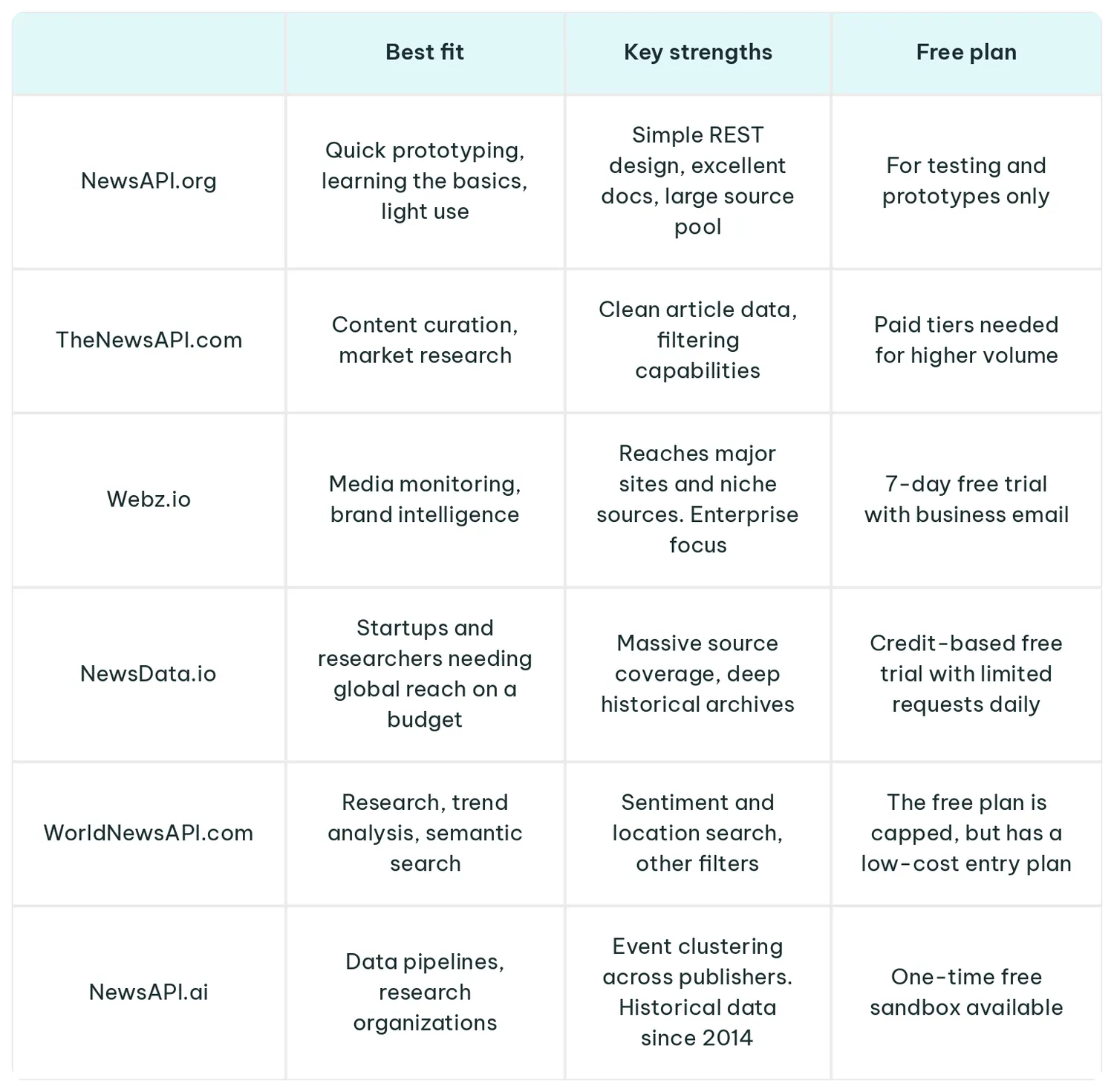
NewsAPI.org
Thanks to its simple REST API, which returns JSON news results, and easy-to-understand documentation, NewsAPI.org is a strong first choice. It offers broad coverage with 150,000 news sources with current and historical data in 14 languages from 55 countries.
The free plan is great for testing with 100 API calls, but it’s limited to prototypes due to a 24-hour delay and articles up to a month old. Since the paid plan is expensive, starting at $449 per month, consider other tools after learning the basics of news APIs.
TheNewsAPI.com
This API stands out by providing full-text searches and many filtering capabilities, ensuring you have clean and duplicate-free article data. Over 40,000 sources across more than 50 countries, 30-plus languages, and indexes of more than 1 million new articles weekly are used.
TheNewsAPI.com structures outputs in a format suitable for content curation and topic research right out of the box. While the free plan is quite limited, the basic plan is among the most affordable at $19 per month for 2,500 daily requests.
Webz.io
Webz.io news API positions itself as an enterprise option that can extract data from the biggest news publishers and other sources, such as Bing News or blogs. It’s most useful for on-demand brand intelligence and media monitoring where targets are difficult to track, and you need a custom solution.
The main selling point of this API is reliable performance and capabilities rather than easy setup. There’s a 7-day free trial available once you register with a business email. Otherwise, the pricing isn’t openly listed and is adjusted based on your target news sites and volumes.
NewsData.io
NewsData.io is powerful on both scale and breadth, covering over 97,000 news portals across 206 countries and 89 languages, and enabling the creation of live breaking news feeds. It can also function as a more specialized solution for cases like Google and Bing news API or Crypto and coin markets API.
The free plan gives 200 API credits per day, and it’s delayed by 12 hours. Paid tiers give you more credits, real-time article availability, AI summaries, and, on higher tiers, historical data access since January 2016.
WorldNewsAPI.com
WorldNewsAPI.com covers sources in over 86 languages from more than 210 countries with real-time capabilities. The main standout feature is its semantic and location search, allowing you to find what’s most relevant for you. The API is also easy to integrate with Artificial Intelligence tools due to its Model Context Protocol support.
The free version is among the most limited, with only 50 points for requests and a one-month history. Yet its cheapest Reporter plan is well-suited as an affordable entry point for individual researchers.
NewsAPI.ai
Event Registry is one of the leading news intelligence platforms, so their NewsAPI.ai API is definitely worth a look. As the name suggests, it’s built around clustering news coverage into events rather than just returning articles or headlines. The tool also stands out for its historical context dating back to 2014.
The free plan gives one-time access to 2,000 tokens with all the main features bundled with other higher volumes. The expenses with this tool grow quickly, however, as 5,000 searches already cost $90 per month.
Real-Time Breaking News vs Historical News
It’s crucial to know the difference between these two use cases, as conflating them might lead to picking an API that isn’t relevant for your use case.
- Real-time news features require low-latency, frequent polling, and category filters, so you’re alerted to news articles when it matters. Free tiers of APIs often have delays, which defeats the purpose of using them for trading alerts, breaking news widgets, or similar use cases.
- Historical news features take a different approach entirely. Archive depth and completeness are most important, so you need full articles with publication dates without much other metadata. Some providers limit these features in lower tiers.
The choice isn’t always a categorical dilemma. Chances are, your needs are somewhere in between live news feed alerts and the ability to find relevant articles from the past.
Combining both to some extent can give your project the flexibility to cover both use cases. This might require combining multiple scraper APIs, so you’ll need to take extra care to align endpoint search syntax filters and other details.
How to Choose the Best News API for Your Project
Web scraping best practices dictate that before building your stack, one must define the use case and match potential specs to it by validating in real use. The same applies when you’re working with news snippets, articles, or similar content.
Some of the common use cases include building a content feed, alerting bots, and financial dashboards. News APIs are also frequently used for media analysis, academic research, or AI summarization tools.
Once that’s settled, answer a couple of key questions while considering each of the APIs we discussed:
- Global or regional coverage?
- Which languages do you need?
- Do you need full text or just metadata?
- How much historical depth is required?
- How reliable is the source quality?
- Do you need advanced features like entity recognition or clustering?
- Can you make do with the free tier?
- At what plan tiers is commercial use permitted?
After you narrowed down your choices to a couple of the most fitting APIs, try to run a proof of concept with identical queries. Compare results, their formats, latency, and general data quality side by side.
Such a comparison will help you evaluate the value each tool gives while ignoring all other factors that might not be so important. Only after comparing data quality should you look into support, documentation, product roadmap, and other highly marketed features.
Conclusion
There’s no one best News API for all use cases, and you’re likely to change a few over the course of a long project. That’s why it’s best to start by using a couple of different API providers, have a backup scraper, and learn to adjust to changing needs and data collection challenges.
FAQ
Which news API is best for getting global breaking news headlines for free?
Unfortunately, every news API provider caps its free tier to limit allowed requests or delays for real-time news. NewsData.io and NewsAPI.ai stand out by offering free news data that could be used for breaking news headlines, but it’s still limited compared to paid API versions.
Can I legally display full text from a news API on my website?
It depends on the licensing agreement of the news publishers, not just API access. Some API providers explicitly prohibit commercial use or full-text redistribution, while others offer paid plans with permissions from some portals. The legal requirements frequently change, so be sure to check each provider’s current terms.
How far back do historical news APIs usually go?
Free plans are often limited to 30 days or even less, while paid plans can extend much further. Some providers allow requesting news articles as old as eight years, and some datasets go even further. Archive depth varies greatly, so it’s recommended to make some tests before committing to a yearly subscription.
Is a JSON API better than using RSS feeds for news data?
JSON APIs offer richer filtering, better structured data, metadata, consistent schemas, and are the web scraping standard. RSS feeds are simpler but limited to whatever fields the publisher includes. RSS feeds are an option for small-scale use of single sources, while web scraping APIs build professional data pipelines.