5 Best Price Intelligence Tools for Ecommerce and Retail in 2026
Software comparisonsCompare the 5 best price intelligence tools for ecommerce in 2026. Track competitors, protect margins, and scale.


Karolis Toleikis
Key Takeaways
-
Match your price intelligence software to your team's technical skills. Buying a complex enterprise tool for a small team usually leads to poor adoption and a wasted budget.
-
Data quality beats data volume. Poor product matching triggers incorrect price changes that can eat into your margins.
-
Implementing competitive price intelligence tools works best as part of a broader strategy. Combine accurate external tracking with a clear grasp of your own internal costs.
Shoppers will switch brands for a better deal, which makes daily pricing visibility a distinct competitive advantage critical to your bottom line. Price intelligence tools let you track competitor product prices and adjust your own before they hit your quarterly targets.
This guide evaluates five of the top automated price tracking tools on the market. We’ll cover the exact criteria you need to choose the right software for your catalog and technical setup.
How We Chose the Best Price Intelligence Tools
We built our assessment around core capabilities that determine whether a platform actually saves time or just creates more manual work.
- Data accuracy and freshness. You need to know exactly how often the platform updates and whether its SLAs guarantee those refresh rates. Stale data means missed pricing trends, market trends, and lost revenue.
- Product matching precision. The system must connect identical and variant items across competitor sites, even when sellers use slightly different titles or images.
- Scalability. A solid platform maintains its speed and performance regardless of the scale of your needs.
- Integration capabilities. Look for smooth integrations that push data directly into your ERP, CRM, BI dashboards, and pricing engines to support real-time pricing adjustments.
- User interface and implementation. Non-technical team members need to be able to navigate the dashboard easily. The onboarding process should get them up and running without endless IT support.
- Geographic and marketplace coverage. The tool must support the specific countries, languages, currencies, and marketplaces where you actually operate.
- Pricing transparency. We looked for vendors who clearly state their subscription tiers, SKU limits, and refresh frequencies so you know exactly what you’re paying for.
- Reliability and track record. We verified their SLAs and checked documented customer outcomes to ensure they deliver the data accuracy they promise.
Top 5 Price Intelligence Tools for Competitive Pricing
The top platforms solve the core problem differently. Some prioritize massive data scale, while others focus heavily on algorithmic recommendations.
Bright Insights (Bright Data)
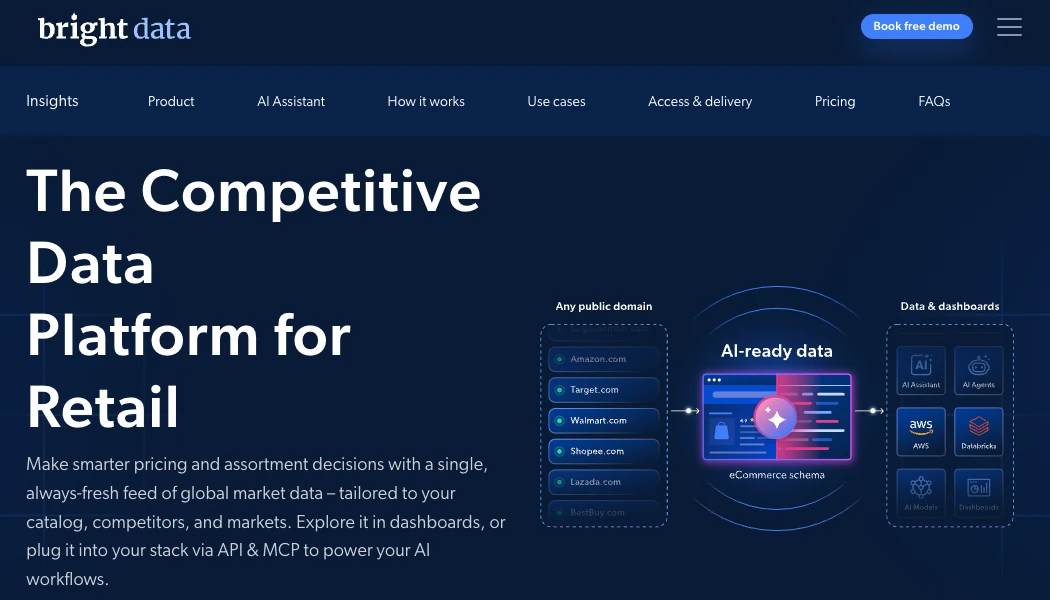
Bright Insights is built on top of Bright Data’s massive global proxy network, which gives it an unmatched ability to pull data from heavily protected retail sites without getting blocked.
However, rather than just dumping raw data, it transforms the information into structured data and layers AI-driven analytics, customizable dashboards, and real-time alerts over that extraction pipeline to turn raw pricing feeds into a clear pricing strategy.
Why it stands out: While many tools struggle with anti-bot protections, Bright Insights leverages a massive global proxy network to bypass aggressive retailer blocks and maintain consistent data flows.
Best for: Enterprise retailers and brands that need a blend of highly reliable data extraction and out-of-the-box visual analytics.
Key strengths: The proxy architecture ensures reliable data collection, so you rarely miss a price change due to a blocked scraper, while the built-in dashboards and AI assistant allow non-technical users to query the data in plain language.
Possible limitations: Because it’s an enterprise-grade platform built on premium extraction infrastructure, the starting costs and sheer volume of available data modules can be overkill for small businesses looking for a simple repricer.
Competera
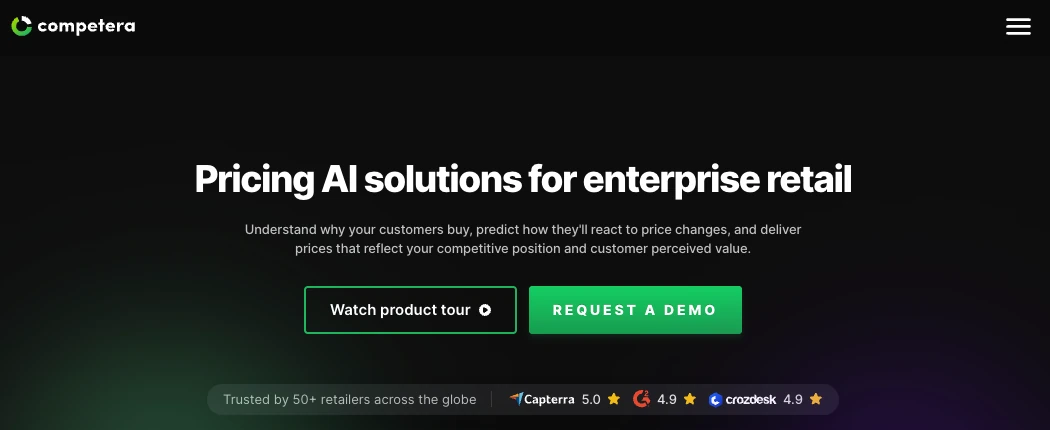
Competera is a predictive pricing engine created for advanced pricing optimization. Instead of reacting to competitor price changes, it uses deep learning models to balance your sales volume against margin goals.
You can let the system automatically adjust prices based on predicted shopper behavior, making it ideal for managing highly volatile product categories.
**Why it stands out: **It looks past basic competitor price-matching to actively predict how your shoppers will respond to specific price changes.
Best for: Mid-to-large retailers who want to automate dynamic pricing based on predictive machine learning rather than static rules.
Key strengths: The system accurately calculates cross-product elasticity, understanding how a price change in one item affects the sales of another, and pushes automatic updates to protect your overall margin.
Possible limitations: Because neural networks require deep historical sales data to train, the initial setup and integration phase is longer and more complex than for a simple rule-based repricer.
Intelligence Node
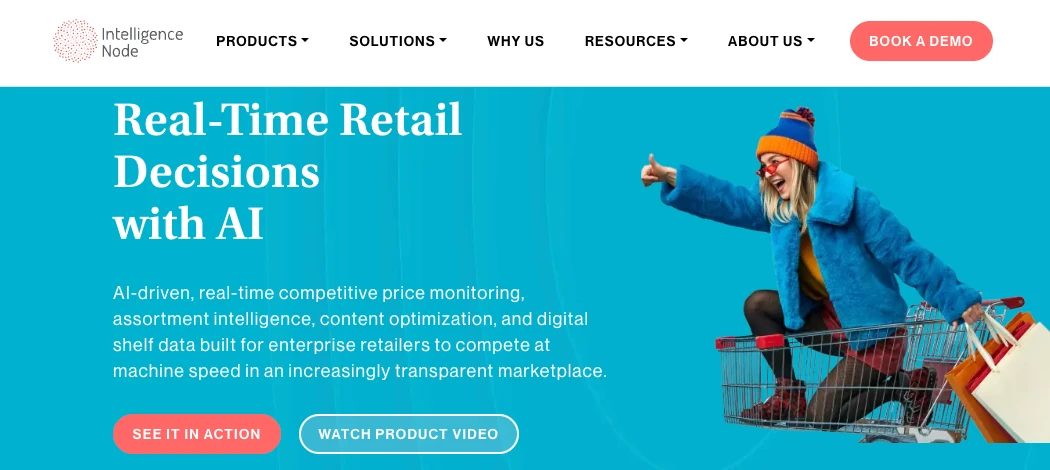
Intelligence Node runs a real-time tracking suite built on a massive proprietary database. This gives global brands access to real-time market data, showing exactly how their products move across borders and third-party marketplaces.
While tracking thousands of items globally typically causes severe system lag, Intelligence Node handles the load with near-real-time refresh rates, using optimized extraction that bypasses standard scraping bottlenecks.
Why it stands out: The platform uses AI algorithms that guarantee 99% accuracy in matching complex variant structures, backed by a contractual SLA.
Best for: Enterprise brands and global retailers who need to monitor competitor prices across dozens of countries, currencies, and third-party marketplaces.
Key strengths: The native MAP compliance monitoring tracker identifies unauthorized sellers and MAP violations almost immediately, protecting your brand equity and margins.
Possible limitations: Because it is an enterprise-grade platform built for global scale, the pricing and setup complexity will be overkill for smaller independent shops looking for a simple daily repricer.
Prisync
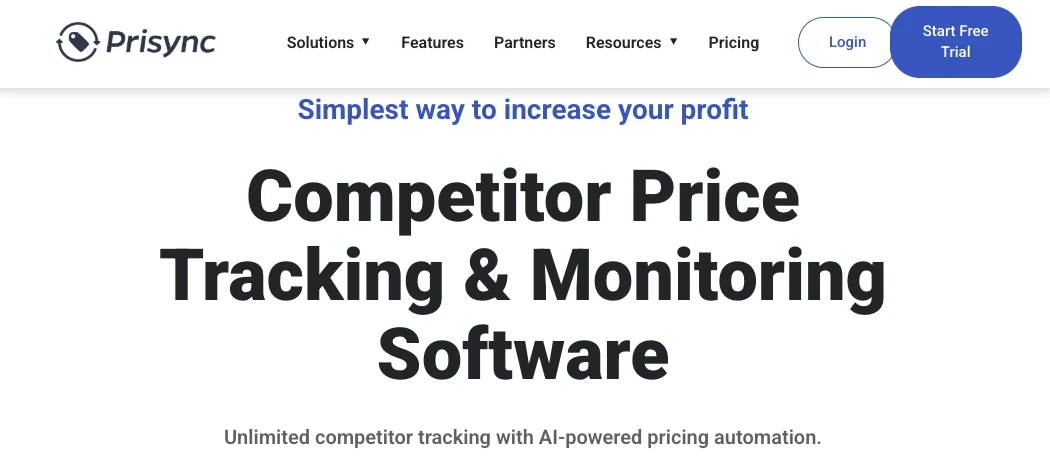
Prisync skips the heavy enterprise infrastructure and offers a clean dashboard perfect for basic competitor monitoring. It connects natively to platforms like Shopify and Magento without requiring custom code, which makes it a favorite for small businesses who need reliable daily benchmarking.
Why it stands out: It offers native, plug-and-play integrations for Shopify and Magento that can be set up in minutes without developer support.
Best for: SMBs, Shopify/Magento merchants, and independent brands looking for an affordable, out-of-the-box tracking solution.
Key strengths: The system triggers automated alerts regarding competitor stock availability and price shifts, all managed from an intuitive dashboard that requires zero technical training.
Possible limitations: It’s not built for enterprise scale. If your needs evolve beyond basic price tracking to millions of SKUs across complex global marketplaces, you will likely outgrow Prisync’s architecture.
Wiser Solutions
Wiser Solutions bridges the gap between digital and physical retail. It deploys a crowdsourced network of shoppers into brick-and-mortar stores, and captures what web scrapers miss.
That includes local store promotions, physical stock monitoring, and poor shelf placement. It makes it invaluable for brands operating on both fronts.
Why it stands out: It combines digital MAP tracking with physical, in-store retail auditing to give you a complete picture of both online and offline pricing compliance.
Best for: Brands and traditional retail chains that need to monitor execution across both digital and physical stores.
Key strengths: The platform unifies online tracking with physical audit data, allowing teams to verify promotional compliance and shelf-level execution from a single dashboard.
Possible limitations: While its digital price tracking operates as a standard SaaS platform, the physical in-store auditing component relies on human shoppers and custom campaign setups.
Quick Comparison of the Best Price Intelligence Tools
Choosing the right price tracking platform depends on your business size, catalog volume, and how fast you need your data to refresh.
| Tool | Best for | Matching accuracy | Data refresh |
|---|---|---|---|
| Bright Insights | Enterprise data teams | N/A (reports only 99.9% capture success rate) | Real-time to hourly |
| Competera | Automated repricing | Up to 98% | Configurable |
| Intelligence Node | Global brands | ~99% | Real-time (10 seconds) |
| Prisync | SMB ecommerce | Unclear | 1-3x daily |
| Wiser Solutions | Omnichannel brands | ~98% | Daily |
Which Option Is Best for You?
There is no single perfect tool. The right choice depends entirely on your catalog size, geographic reach, and how deeply you need to integrate the data into your existing systems.
- Bright Insights. Best for enterprise brands that need a highly reliable data extraction pipeline paired with out-of-the-box visual analytics and AI-driven insights.
- Competera. Best for mid-to-large retailers who want to move beyond simple price-matching and use predictive machine learning to automate their dynamic pricing.
- Intelligence Node. Best for global brands and enterprise retailers that require 99% matching accuracy and real-time MAP compliance tracking across international borders.
- Prisync. Best for small brands and Shopify/Magento store owners who need a lightweight, plug-and-play daily repricer.
- Wiser Solutions. Best for omnichannel brands that need a hybrid solution combining online MAP tracking with physical store audits.
FAQ
What is a price intelligence tool and how does it work?
A price intelligence tool is software that automatically pulls pricing data from competitor websites, marketplaces, and advertising channels into a single dashboard. It uses scraper scripts or APIs to gather competitive data, then applies matching algorithms to link identical products across different sites so you don’t have to check them manually.
How often should competitor prices be monitored?
The ideal frequency depends on your volatility within highly competitive markets. If you sell fast-moving consumer goods or electronics, you might need hourly or real-time data to keep up with aggressive algorithmic repricing. If you sell specialized industrial equipment or luxury goods, tracking prices once a day or even once a week is usually enough.
Can price intelligence tools work with MAP policies?
Yes. Many platforms include features to help manufacturers enforce their Minimum Advertised Price (MAP) agreements. These tools scan authorized retailer sites and third-party marketplaces, immediately alerting your team if a seller drops their price below the approved threshold. This helps you catch violations early and protect compliant retail partners.
Do I need proxies to run my own price monitoring?
If you build your own price monitoring system, you will need a robust proxy network. Retailers actively use anti-bot software to block scrapers, and a single server sending thousands of requests will get its IP banned almost instantly. Commercial price intelligence software handles all the proxy routing behind the scenes, meaning you don’t have to manage the network infrastructure yourself.
How accurate are automated price intelligence tools?
The best systems typically achieve 95% to 99% accuracy. The most reliable tools capture real pricing and match items using standard product identifiers like UPCs, EANs, or GTINs. Accuracy drops if a tool relies solely on text titles, because retailers frequently alter product names, use abbreviations, or bundle items. For products without standard barcodes, look for platforms that use machine learning, visual recognition, and human validation to ensure accurate matches.