What Is a Proxy Scraper? 9 Best Proxy Scraping Tools
Proxy fundamentals

Milena Popova
Key Takeaways
-
Proxy scrapers automatically collect working proxies from the web, saving time and effort.
-
Proxy lists help with anonymity and scaling, and they’re useful for scraping, automation, SEO, and bypassing geo-restrictions.
-
Free proxies are convenient but risky, as it’s not always clear where those proxies are sourced from.
-
Tools differ by complexity, from beginner-friendly lists to advanced developer platforms with automation and testing.
Whether you need a proxy server for web scraping, market research, or just to bypass geo-restrictions, the right tool will save time and cut costs by providing fast, reliable, free proxies hassle-free.
We’ll review some of the most popular options on the market so you can make a well-informed decision. But first, let’s explain what these tools are and how they work.
What Is a Proxy Scraper and How Does It Work?
Proxy scraper tools are software designed to extract proxy server information from various internet sources automatically. Information collected often includes IP addresses, port numbers, and protocols.
The main goal of using proxy scrapers is to build or update a list of usable proxies for various purposes. Proxy scrapers can gather proxy information from public proxy lists, forums, websites, and other sources where proxy details are available.
What Is a Proxy List?
A proxy list includes information on proxies, and it’s typically used to access the internet. It contains details like the proxy server type (HTTP, HTTPS, SOCKS5, etc.), port, speed, latency, uptime, and sometimes even the country of origin.
The list is made by collecting potential IPs and running them through various filters and tests. The key purpose of a proxy list is to provide users with a selection of proxy servers to choose from for various applications.
Why Would You Need One?
Proxy lists are used when you need to rotate proxies or when you want to assign one IP to each account or user. They keep crawlers and bots anonymous, ensuring uninterrupted operations on the internet.
In more advanced setups, users often turn to web unblockers. Unlike traditional proxy lists, the best web unblockers handle multiple layers of access control automatically - IP management, CAPTCHA prompts, geo-restrictions, and other anti-bot systems.
Common Use Cases of Proxy Lists
Requiring multiple IPs or rotating them is common for automated bot-driven activities, brand protection, price comparison, and travel aggregation, all of which need a proxy list. Here are the most common use cases of proxy lists:
- Web scraping
- Anonymous browsing
- Bypassing restrictions
- SEO monitoring
- Market research
- Price comparison
- Travel aggregation
- Automation and bot workflows
Free Proxy Lists
A free proxy list comprises IP addresses you can access without charge. In other words, it’s a list of free proxies you can use for your online operations. They can offer different proxy types based on performance, speed, and specifications.
But as with any free service or product, it’s crucial to look for a trustworthy provider. While not all free proxy servers are blocked or misused, some are.
Potential Dangers of Using a Free Proxy Server
A free proxy server is enticing for users seeking a quick solution, but can come with potential dangers and drawbacks. Some of the main concerns include:
- Data leaks
- Unreliable performance
- Slow speeds
- Limited location availability
- Unsupported protocols
- Incompatibility with certain websites
That’s why you must be careful when choosing your provider and ensure you can trust it with your sensitive data. Look for a reputable name in the proxy world instead of risking your privacy and security online.
9 Best Proxy Scraping Tools – Review
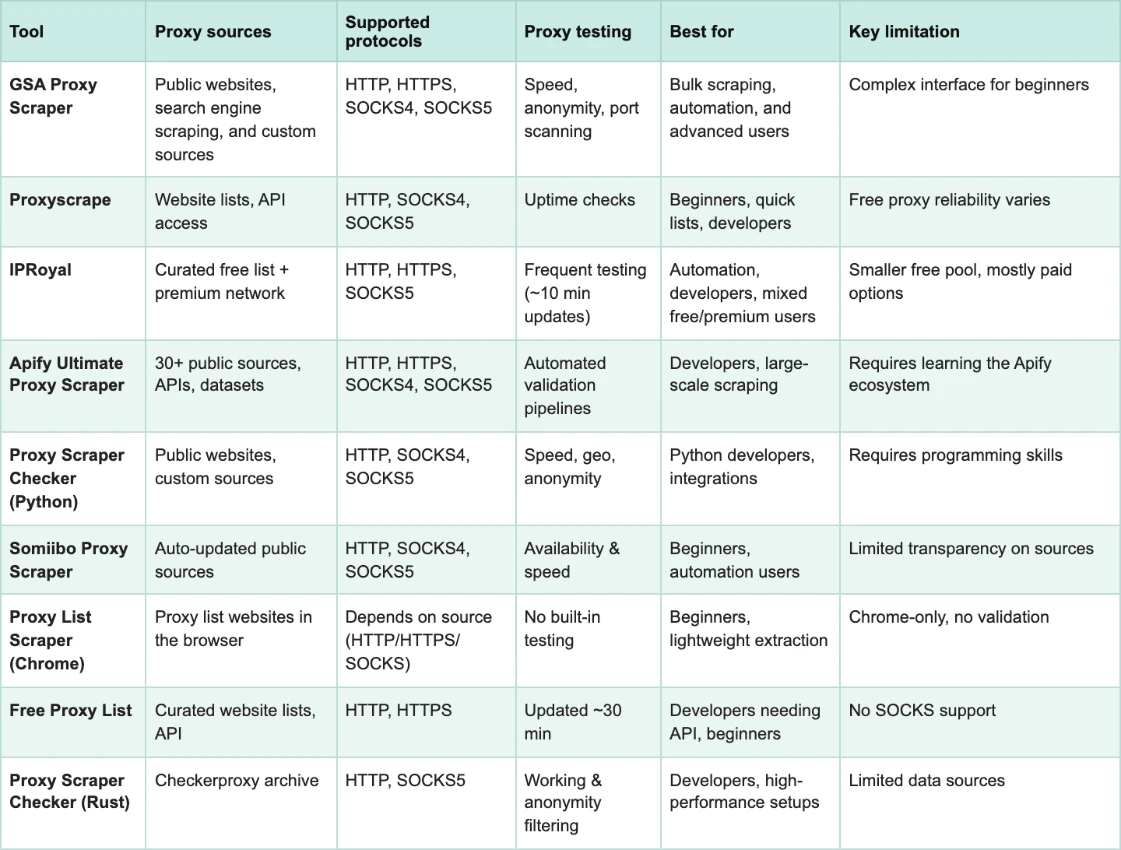
Here’s a quick review of some of the best options on the market. They are listed in no particular order, so consider their features, pricing, and user experience when making a decision.
1. GSA Proxy Scraper
GSA Proxy Scraper is a desktop tool that automatically finds, reviews, tests, and even manages proxy servers. Versatility is why many companies and professionals use GSA as an all-in-one solution for collecting proxies for SEO, web scraping, and automation.
- Proxy sources: Public proxy websites, search engine scraping, user-added sources
- Supported protocols: HTTP, HTTPS (CONNECT/WEB), SOCKS4, SOCKS5
- Proxy testing & validation: Has advanced (speed tests, anonymity detection, port scanning)
- Best for: Bulk scraping, automation, advanced users
- Key limitation: High complexity; not beginner-friendly
- Pricing: One-time payment of $97
2. IPRoyal
IPRoyal is mostly known for our premium solutions, but we also offer a free proxy list , including HTTP, HTTPS, and SOCKS5 proxies. All proxies are tested and updated every 10 minutes, so you can rest assured they are fresh and working.
Users can choose from thousands of IPs based on their protocol and location, down to the city level. If you’re looking for premium residential proxies , IPRoyal has non-expiring traffic starting at only $7 per GB.
- Proxy sources: Curated free proxy list via website (plus premium network)
- Supported protocols: HTTP, HTTPS, SOCKS5
- Proxy testing/validation: Includes advanced features like frequent testing and updates every ~10 minutes
- Best for: Developers, automation, users needing reliable free + premium options
- Key limitation: Free pool size is smaller compared to paid offerings
- Pricing: Separate pricing plans for datacenter, mobile, residential, and ISP proxies
3. ProxyScrape
ProxyScrape is a proxy service platform with a particular focus on distributing multiple IPs at the same time. For marketers and developers who need to access different geographic locations for research and data extraction, ProxyScrape offers a comfortable interface and API integration.
While ProxyScape isn’t a scraping tool, it offers massive amounts of residential, mobile, and datacenter proxies with highly flexible plans fit for everyday users and businesses.
- Proxy sources: Public lists provided via website downloads and API
- Supported protocols: HTTP, SOCKS4, SOCKS5
- Proxy testing/validation: Basic features like regular uptime checks
- Best for: Beginners, quick proxy access, developers needing simple lists
- Key limitation: Free proxy quality can be inconsistent
- Pricing : 1-day plans start from $4 for 1000 proxies
4. Apify’s Ultimate Proxy Scraper
The Ultimate Proxy Scraper from Apify lets you scrape thousands of proxy servers from over 30 data sources. The scraper is optimized to scrape thousands of proxies. This proxy scraper uses multithreading and automated validation to improve speed and accuracy.
- Proxy sources: 30+ public sources, APIs, and datasets
- Supported protocols: HTTP, HTTPS, SOCKS4, SOCKS5
- Proxy testing/validation: Advanced (automated validation pipelines)
- Best for: Developers, automation workflows, large-scale scraping
- Key limitation: Requires familiarity with the Apify platform ecosystem
- Pricing: $5.00/month, which can increase with usage
5. Proxy Scraper Checker
Proxy Scraper Checker is an up-to-date proxy scraping tool available on GitHub . It’s written in Python, so it’s ideal for Python programmers who need proxies for constructing client-based applications. This tool can show the proxy’s anonymity level and the geolocation of its exit node. You can download it for free from GitHub.
- Proxy sources: Public proxy websites and user-defined sources
- Supported protocols: HTTP, SOCKS4, SOCKS5
- Proxy testing/validation: Has speed sorting, anonymity detection, and provides access to geographic information
- Best for: Developers (especially Python), custom integrations
- Key limitation: Requires programming knowledge to use effectively
- Pricing: Free
6. Somiibo
Somiibo Proxy Scraper is a free proxy scraping software that can find and test thousands of proxies in an instant. It’s easy to use and lets you choose whether to search a proxy server by protocol, anonymity, or country.
The tool is automatically updated with new proxy sources, and the proxies are regularly checked to ensure you get fresh IPs with good speeds.
- Proxy sources: Automatically updated public proxy sources
- Supported protocols: HTTP, SOCKS4, SOCKS5
- Proxy testing/validation: Provides basic to moderate features like wide availability and fast proxy checks
- Best for: Beginners, automation users, social media tools integration
- Key limitation: Limited transparency about proxy sources and testing depth
- Pricing: Free
7. Proxy List Scraper
A Chrome extension that can help you extract proxies from proxy list websites using only your browser. For those who have Chrome on their phones and computers, it’s a great option to consider. Using the tool is pretty straightforward – you visit a site with free proxy lists and enable the extension.
- Proxy sources: Proxy list websites visited in the browser
- Supported protocols: Depends on source (typically HTTP/HTTPS/SOCKS)
- Proxy testing/validation: No built-in testing
- Best for: Beginners, quick manual extraction, lightweight use
- Key limitation: Chrome-only and lacks validation features
- Pricing : Free
8. Free Proxy List
It’s not a proxy-scraping software, but rather a provider offering free proxy lists updated every 30 minutes. The provider’s API allows you to customize the output format of the list and filter the proxies by country.
- Proxy sources: Curated public proxy lists via website and API
- Supported protocols: HTTP, HTTPS
- Proxy testing/validation: Updates around every 30 minutes
- Best for: Developers needing API access, beginners
- Key limitation: No SOCKS support, and free proxy reliability varies
9. Proxy Scraper Checker
Lastly, Proxy Scraper Checker is another up-to-date proxy-scraping tool written in Rust and available on GitHub and lib.rs . The software scrapes and checks SOCKS5 and HTTP proxies from the proxies archive on checkerproxy.net .
- Proxy sources: Proxy archive from checkerproxy.net
- Supported protocols: HTTP, SOCKS5
- Proxy testing/validation: Shows working status and anonymity filtering
- Best for: Developers, automation, high-performance environments
- Key limitation: Limited sources compared to multi-source scrapers
- Pricing: Free
Conclusion
Proxy scrapers can help you get your hands on free lists of proxies so you can collect data from any site you want without investing in costly proxy services. Explore our selection of leading proxy scraping tools and reliable providers offering free proxy lists, and choose the best solution for you.
FAQ
Are proxy scrapers legal to use?
Yes, proxy scrapers are legitimate tools for collecting publicly available proxy server information from archives, websites, or even APIs. However, to avoid any legal issues, users should always adhere to local laws and policies on proxy use and data gathering.
Are free proxy scrapers safe?
Generally, any free service online carries certain risks, especially when those services require users to log in and share important personal information.
While free services themselves can be safe, the same cannot be said about those proxies. Some of the most common risks can include unauthorized monitoring, insecure connections, or performance loss.
What are the risks of using a proxy scraper?
Proxy scrapers are great tools, but there are risks you should be aware of before you start using them.
- Some proxies inject ads, malware, or tracking scripts
- The proxy operator can can capture unencrypted traffic
- Misuse for prohibited activities can lead to penalties
- Websites already block many public proxies
- High failure rates and frequent downtime
How accurate are free proxy scrapers?
Relying on free proxies is often a hit or miss. When it comes to free proxy scrapers, evaluating accuracy can be difficult. Even if a scraper can validate proxies, free proxies can come with network reliability issues, latency fluctuations, rate limits, or outdated data handling processes.
Can websites detect scraping when using proxies?
Yes. While proxies do minimize detection risks, IP bans, and mask your connections, they can’t hide online actions. So, once you start scraping, websites will be able to detect behavioral patterns, device fingerprints, session details, and bot activity. The best way to ensure your activity stays undetected is to use the best web scraping proxy providers .
Can a proxy server be traced back to me?
Most proxies, particularly trusted paid proxy service providers, can mask your connections entirely. However, sometimes proxy servers can be detected with proxy provider logs, payment records, browser fingerprinting, incorrectly configured anonymity tools, and ultimately, law enforcement requests.