AI Training Data: Types, Sources, and Best Practices
AIDiscover everything you need to know about AI training data, including data types, sources, preparation methods, and best practices for successful AI development.


Eugenijus Denisov
Key Takeaways
-
A smaller collection of clean, accurate data is much better than a massive pile of messy, incorrect data.
-
There are typically three training data splits: training, validation, and testing.
-
All collected data has to be in line with privacy and copyright law and adhere to ethical standards.
-
Collecting information from the internet is a great way to train AI, but you need a reliable network of proxies to avoid getting blocked by websites.
Artificial intelligence might have been a science-fiction concept just a few decades ago, but today it has become a major driving force in modern software. AI can write code, translate languages, and even help drive cars. Reaching that level of advanced AI requires a lot of high-quality data, as the capabilities of AI models depend on the data used to train them.
Without good data, even the most advanced AI programs can become useless. That’s why engineers have to monitor the performance of their AI models and algorithms constantly. But today, the focus is shifting towards the data used for training AI models.
This guide will explain everything you need to know about AI training data. We’ll cover the main data types, where it comes from, how to prepare it, and the best practices to follow for building a successful AI model.
What Is AI Training Data?
AI training data is a collection of information used to teach an AI model. It can be text, pictures, videos, audio recordings, or numbers in a spreadsheet. During training, AI uses the provided data to identify mathematical patterns.
For example, if data scientists give an AI model thousands of credit card transactions, it will start compiling lists of grouped information, such as when the card was last used and where. Sensitive personal information is highly protected and typically not used for AI training; however, some financial and government institutions may be able to create such models.
Simple Examples of AI Training Data
- Self-driving cars: Manufacturers use thousands of images and videos to mark pedestrians, lanes, intersections, traffic lights, signs, and other important elements.
- Customer support chatbots: Old customer service chat logs and emails are labeled by topics like refunds or password resets so bots can learn to identify issues and respond appropriately.
- Medical diagnostic tools: X-rays, MRI scans, and data from other devices are interpreted by medical professionals to help identify immediate issues such as tumors or broken bones.
Training Data vs. Validation Data vs. Test Data
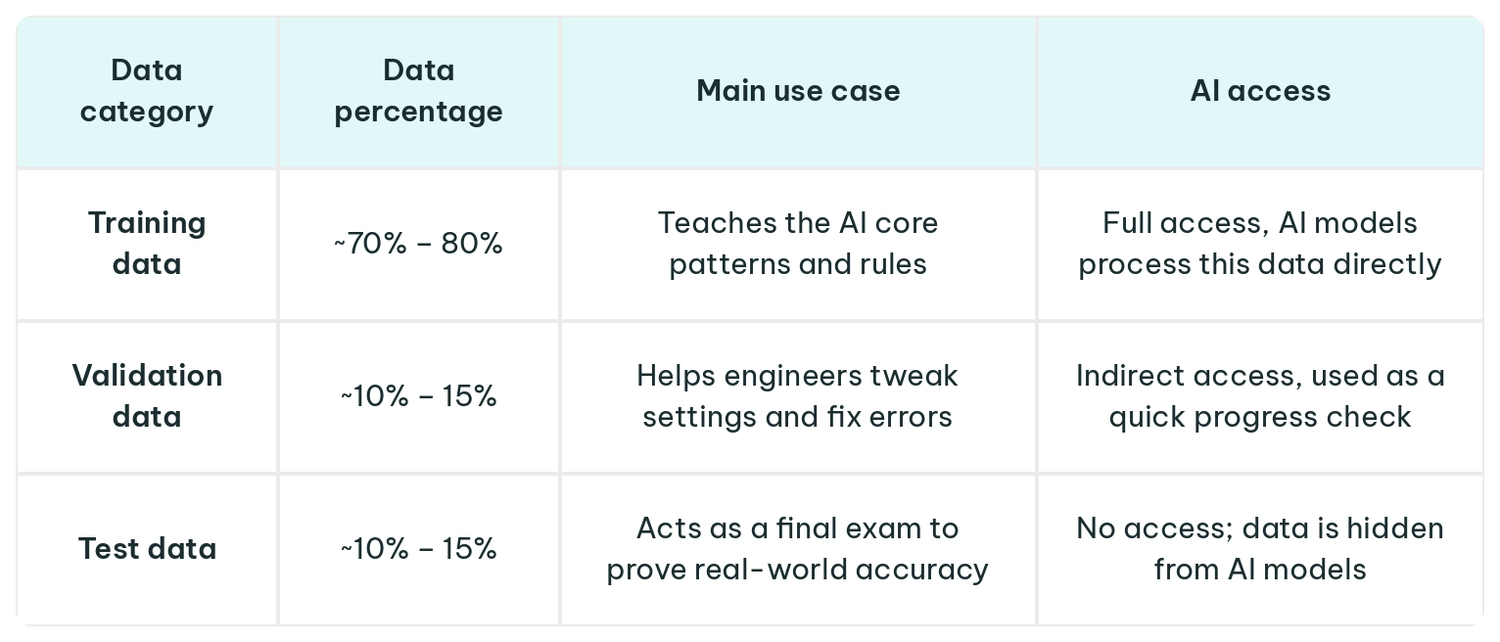
When building an AI model, engineers never use all their data for training in one go. If they did, they wouldn’t be able to test whether the AI is accurate in the real world or merely repeats the patterns found in the training data, otherwise called overfitting.
To avoid this, engineers split their data into three separate categories: training, validation, and test data.
Why AI Training Data Matters
Data is the single most important factor in building successful AI models. If you provide high-quality training data, you’ll get high-performance and accurate models. But if you give it bad or low-quality data, your AI models will return inaccurate or even false responses.
In the industry, it’s often referred to as garbage in, garbage out when referring to how data quality affects AI models.
- Performance and reliability: All AI models rely on high-quality data to accurately reflect reality, whereas flawed data can distort their logic and lead to costly mistakes.
- Preventing bias: AI models work with existing information and look for patterns, so if there’s bias, AI will likely perpetuate the same bias, which is why it’s crucial to check all training data.
- Business value and ROI: Using clean and accurate data from the get-go will help make sure AI models work as intended, reducing operational overhead on retraining.
- Rules and compliance: All data has to be sourced legally to adhere to strict global regulations like the EU AI Act and GDPR to avoid fines and other legal issues.
| Disclaimer: The information provided in this article is for educational purposes only and shouldn’t be considered as legal advice. |
|---|
- Quality over quantity: A smaller, carefully cleaned dataset will always be better and outperform a massive set of unorganized, spam-filled web data.
Main Types of AI Training Data
AI models use different kinds of data depending on the task. New updates to existing large language models (LLMs) have made it possible to use more than one type of data to train AI models. Even so, there are at least a total of 5 distinct data types used for AI model training.
Text Data
This type of data is the most basic one and is typically used to train language tools like chatbots. Text data can be books, online articles, customer emails, and code repositories. However, before an AI model can read the provided text, engineers have to clean it up by breaking it down into smaller segments to remove unnecessary or redundant words or phrases.
Image and Video Data
Computer vision (CV) systems are a major branch of AI and use images and videos to see the world. This includes photos, satellite images, and medical scans. Video data is harder to process than photos because the AI also has to track how objects move and change over time, so there’s quite a bit of manual oversight required.
Real-world applications include license plate recognition for toll road systems, identifying faulty wires in telecommunication cabinets in the field, training medical imaging diagnostic tools, etc.
Audio and Speech Data
Audio data is what powers voice assistants and speech-to-text tools. AI model engineers or other teams use voice recordings, podcasts, and phone calls to turn audio waves into visual graphs of sound frequencies so AI models can understand words and even accents, although this would require considerable resources to accomplish.
Structured and Tabular Data
This is your typical business data organized in rows and columns, much like you’d see in a spreadsheet or a structured query language (SQL) database. Examples include financial records, customer ages, or inventory lists. The best thing about using this type of data is that it’s already organized and is easy to process for traditional machine learning models.
Synthetic Data
In cases that depend on rare, expensive, or private data, data engineers use synthetic data. It’s essentially fake and usually generated by a computer script that behaves exactly like real data. A common example of using synthetic data is to simulate rare car crashes to train self-driving cars safely.
Labeled vs. Unlabeled Training Data
| Feature | Labeled data | Unlabeled data | Semi-supervised data |
|---|---|---|---|
| Definition | Data with the correct answers attached | Raw data with no tags or answers | A tiny bit of labeled data mixed with a lot of raw data |
| How AI uses it | Supervised learning (guided) | Unsupervised learning (independent) | A blend of guided and independent learning |
| Cost | High (takes a lot of human labor) | Low (easy to collect in bulk) | Medium (saves time and money) |
| Example | Sorting spam emails | Grouping customers by shopping habits | Training large language models |
Where Does AI Training Data Come From?
While AI training data has 5 different types, they all come from different sources not always associated with the listed data types. This is because not all data is publicly available, so businesses and teams need to balance cost, time, and privacy rules.
Internal Company Data
This is highly valuable data that companies already own, such as customer purchase histories, app usage statistics, or archived support emails. Internal company data is unique and, if used correctly, can give businesses a competitive edge.
Public Datasets
Universities and governments often share free datasets for anyone to use. Examples include massive collections of photos or public census records. While these are free, they do not give a competitive advantage because anyone else can use them too.
Licensed Third-Party Datasets
Sometimes companies pay specialized data companies to buy high-quality data. This is common for industry-specific information, like verified medical records or official financial market history. One trade-off to consider is that this type of data sourcing is expensive, but it’s usually clean and legally safe to use.
Web Data
The internet is by far the largest source of data today, allowing virtually anyone to benefit from online information as long as it’s public. AI companies collect this public data from websites, forums, and online reviews, but gathering it requires building a strong scraping system that ensures data is ethically sourced, accurate, and structured.
Data Augmentation
This can be considered a method to grow the datasets you already have without actually collecting new files. Teams do this by using existing information and slightly modifying it, such as rotating a picture, adjusting its brightness, or swapping words with synonyms in sentences.
Coupled with internal data, these two sourcing methods can prove to be hugely beneficial for large businesses that have data to rely on.
| Data source | Scaling capabilities | Cost | Business benefit | Main risk |
|---|---|---|---|---|
| Internal data | Limited to your business | Free to low | Very High | Might be disorganized or missing pieces |
| Public datasets | Limited to what’s online | Free | None | Accessible to everyone, can be outdated or incorrect |
| Licensed data | High | High | Medium | Expensive and may come with strict usage rules |
| Web data | Almost Unlimited | Medium | High | Websites change and can block your tools |
| Data augmentation | High | Low | Medium | Might create unrealistic examples |
How AI Training Data Is Collected and Prepared
As with nearly every project, success depends on how well you prepare for it and plan ahead. This is especially true for building a reliable data collection process, and it should be approached systematically.
Step 1: Set Your Goal
Set a clear goal or definition of what you want your AI model to focus on. This will make it easier to decide which data types to use and where to get them. For example, if you want your AI model or models to predict when a factory machine will break down, you need to collect data from machines right before they broke down in the past.
Step 2: List Your Data Needs
Figure out what kind of files, formats, and data quantities you need. This is also where you plan how to keep the data fair, balanced, and compliant with privacy laws, which is a major consideration if you decide to use public data from the web.
Step 3: Collect Raw Data
This is the stage where the actual data collection process begins and is typically handled by data engineers or trained teams. They pull records from company databases, download public files, or use automation scripts to save public info from the web.
Step 4: Clean and Organize the Data
Raw data is incredibly messy. Once you or your team gather a sufficient amount of data, it then needs to be cleaned and structured. Engineers run cleanup scripts to delete duplicate files, fix missing information, remove weird formatting, and make sure all dates and numbers use the same format.
Step 5: Label the Data
Even after the initial data cleaning, it needs further processing. Specifically, to prepare data for training datasets, you’ll need to tag the information you’ve gathered. Data labeling is arguably one of the most time-consuming processes, but it’s also the most important.
It’s important to note that in the AI industry, data labeling and data annotation are often used interchangeably – but they’re not exactly the same. Annotation typically implies more complex tagging, like drawing bounding boxes on images or semantic tagging in text.
Step 6: Split the Dataset
After you’ve successfully cleaned and labeled your data, the next thing to do is to split the data into three categories: training, validation, and testing data. After that, it’s worth double-checking whether the data assigned to the training categories is correct and doesn’t show up in more than one category.
Step 7: Keep It Updated
The final step is crucial for ensuring your data gathering process remains functional and uses the right and accurate data for training. On top of that, since everything changes so rapidly, you should also make a point of adding fresh data for AI model accuracy.
What Makes High-Quality AI Training Data?
| Relevance | The target data must be relevant and match the training goal |
|---|---|
| Accuracy | All tags and facts must be completely true and correct |
| Completeness | Data should be complete and clean to avoid fragmentation or blind spots |
| Diversity | The data should be clear and diverse while still relevant to the overall goal |
| Freshness | The data must reflect current trends, current laws, and modern habits |
| Regulations | You must have clear permission to use the data, and all private personal details must be removed |
| Consistency | All files must follow identical formats and measurements across the board |
| Traceability | You should have a clear record showing exactly where the data came from and how it was modified |
Common AI Training Data Challenges
While planning ahead and following predetermined steps can make all the difference in creating a successful data gathering workflow, there can still be challenges. Here’s a breakdown of some of the more common obstacles:
- Human bias: If your historical data is unfair to certain groups, your AI will automate and perpetuate that unfairness.
- Human error: People can make mistakes and get tired, so if some files get tagged incorrectly, your AI model will get confused.
- Duplicate data: Using the same data for AI training can result in AI models over-focusing on that data, which in turn can skew later results once the models are ready to be used.
- Data scarcity: Not all data is equal, and often unique or edge cases lack the necessary data to train AI models.
- Copyright and privacy: Using private user data or copyrighted creative work requires going through the right channels to get approvals.
- Getting blocked online: Many websites use strict anti-bot systems to prevent large-scale and indiscriminate data collection.
Web Data for AI Training
When Web Data Is UsefulI
Many modern tools are built on real-time, constantly changing information, so web data is not just necessary but mandatory. The internet captures how humans talk, what consumers buy, how global markets shift, and what new trends come by – all of which simply can’t be covered by internal data alone, making web data vital.
Why Proxies Matter for AI Data Collection
Despite the internet offering seemingly endless sources of data, collecting the data you need isn’t as simple. For one thing, public data is subject to change and can therefore be inaccurate. On top of that, gathering large amounts of data at scale means sending thousands of connection requests, which is both slow and can easily be blocked.
That’s why so many web scraping tools are often paired with additional services like proxies. These servers stand between you and the end destination you want to connect to. In doing so, your internet protocol (IP) address is secured and hidden by a different IP address from another location.
To keep your data pipeline running smoothly, you need to choose a reputable proxy service provider that has the features you need. IPRoyal provides access to a highly scalable network of over 32 million residential, datacenter, and mobile proxies across more than 195 countries. This allows AI teams to collect public web data while minimizing the risk of IP bans or rate limiting.
AI Training Data Best Practices
Now, using the right data, building a robust data-gathering pipeline for cleaning and segmenting the collected data, and training AI models is a considerable amount of work. To make it more manageable, you can review this checklist:
- Set a clear goal first: Clarify what business problem you are trying to solve before gathering any files.
- Focus on data cleanliness: Make sure your data is accurate and correctly labeled rather than just trying to gather as much data as possible from the get-go.
- Use a diverse data mix: Check that your data includes all types of people, environments, and unusual edge cases to prevent bias (depends on use case).
- Maintain a detailed history log: Document where your data came from and who edited it.
- Keep your training data categories separate: Never let your test data mix with your training data, or your final exam score won’t be usable.
- Double-check assigned data labels: Create a secondary review process to catch and correct human errors early.
- Refresh your data regularly: Schedule routine updates to add new data so your AI stays up to date.
- Watch for real-world changes: Monitor your live AI to ensure it continues to perform as it should.
- Use strong infrastructure: Rely on dependable data storage tools and stable proxy networks to keep your automated collection processes running smoothly.
- Review privacy laws early: Make sure any personally identifiable information (if used) is completely scrubbed before your AI starts learning.
Conclusion
The logic behind a high-performance and accurate AI model is simple – use high-quality data, and you’ll get good results. But in reality, building a successful AI tool requires a real commitment to clean, fair, and legally compliant data preparation. Every choice you make while gathering data directly determines how smart your final AI will be.
By prioritizing data cleanliness, respecting user privacy, and utilizing trusted proxy tools like IPRoyal to keep your web data pipelines flowing, your business can build reliable, high-performance AI systems designed for long-term success.
FAQ
How much training data does an AI model need?
There is no single answer because this depends on individual use cases. Simple tasks, like predicting house prices from a spreadsheet, might require only a few hundred rows of data. But building a chatbot or training a self-driving car requires extensive datasets.
What is the difference between AI training data and input data?
AI training data is designed to train models for specific use cases, such as recognizing certain objects in images or identifying specific words or phrases in text. Input data typically refers to the information provided on the spot by different users who are requesting a functioning AI model to perform a task.
What is the difference between training data and inference?
The main difference between training data and inference lies in their use. Training data is what the AI uses to learn its skills. Inference is the actual execution stage where the finished AI uses what it learned to process live inputs and perform its job in the real world.
Can AI-generated content be used as training data?
Yes, AI-generated content can indeed be used to train AI models, and it’s actually called synthetic data. One thing to note is that relying solely on AI-generated content for AI training can cause glitches, which can then result in model collapse as it starts to recognize generated content.
What is data leakage in AI training?
Data leakage describes a situation where data from one test category gets mixed up with another category’s data. This can essentially lead to an AI model cheating at the final exam, showing great but not entirely accurate results.
Is web scraping legal for AI training?
Overall, yes, web scraping is legal in most countries if the scraped data is publicly available and sourced ethically while adhering to the terms of service of individual websites. However, when it comes to whether web scraping is legal for your business, it’s best to consult with specialists.