5 Best Data-as-a-Service Companies in 2026
Software comparisonsCompare the 5 best Data-as-a-Service companies in 2026 to find the ideal data provider for your business.


Arevika Ambarcumian
Key Takeaways
-
Prioritize data accuracy and overall data quality over volume since bad data ruins data analytics.
-
Choose a vendor with automated integrations so new data feeds directly into your current systems.
-
If you run technical data science projects, look for flexible APIs and raw data rather than pre-packaged dashboards.
Prioritize data accuracy and overall data quality over volume since bad data ruins data analytics. Choose a vendor with automated integrations so new data feeds directly into your current systems. If you run technical data science projects, look for flexible APIs and raw data rather than pre-packaged dashboards.
Data-as-a-Service (DaaS) companies provide cloud-based access to specialized information and analytics, allowing businesses to leverage high-quality data on demand without building their own complex infrastructure.
Business owners know they need external data sources to grow, but finding reliable pipelines that avoid heavy engineering is tough. The Data-as-a-Service industry solves this by providing on-demand access to business information through specialized data services, significantly reducing the engineering effort required to gather, maintain, and streamline data management while automating tedious data collection.
This guide evaluates five top Data-as-a-Service providers and helps you choose the right partner for your team.
How We Chose the Best Data-as-a-Service Companies
We evaluated providers using a six-dimension framework that prioritizes system integration and data security alongside raw data volume and your existing data infrastructure.
- We looked at how providers verify their information across various data sources, their recorded accuracy rates for data points, and how often they refresh their databases .
- To ensure practical usability, we checked for automated APIs, batch feeds, cloud connectors, and direct CRM integrations.
- We reviewed subscription tiers and contract terms to ensure platforms can scale as your data usage grows.
- We measured the depth of each vendor’s catalog across B2B records, financial indicators, employment histories, and consumer data, evaluating how their continuous data collection processes compile this aggregated data.
- Data privacy and data security are non-negotiable, so we verified strict compliance with GDPR and CCPA, confirmed ISO 27001 and SOC 2 certifications, and reviewed how each vendor handles suppression lists within their broader data management framework.
- We evaluated each provider’s onboarding programs, developer documentation, and managed services for handling complex data integrations.
Top 5 Data-as-a-Service Companies for 2026
Each DaaS platform is built for a specific use case, so choosing the right one depends entirely on your team’s workflows.
ZoomInfo
ZoomInfo holds the largest contact database for the North American B2B market, with extensive data sources. While they’re known as a comprehensive enterprise data provider, it’s important to note that their native engagement tools and intent data for predictive analytics are largely sold as premium add-ons rather than being bundled into the core platform.
Best for: Large enterprise sales teams running high-volume outbound campaigns targeting the North American market.
Key strengths:
- Massive North American database with deep enterprise reach.
- Strong intent signals to help time sales outreach (available as a paid add-on).
- Native workflows that allow reps to run campaigns directly from the platform.
Possible limitations:
- Strict annual contracts with aggressive auto-renewal clauses and no monthly billing options.
- Major features like intent data, global data, and engagement tools require costly add-ons.
Dun & Bradstreet
Dun & Bradstreet leads the corporate risk and financial data sector. Their proprietary D-U-N-S numbering system acts as a universal identifier used by governments and enterprises to map corporate hierarchies, verify vendor stability, and assess supply chain risk.
Best for: Enterprise procurement, compliance, and risk management teams that require the D-U-N-S number for regulatory and vendor assessments.
Key strengths:
- The D-U-N-S number provides a reliable framework for mapping complex global corporate hierarchies.
- Strong financial and credit risk data for evaluating global suppliers and partners, giving teams the required operational data to enhance their risk-related data analysis.
- Native integrations with major enterprise systems like Salesforce, SAP, and Oracle.
Possible limitations:
- Highly fragmented pricing, where sales intelligence, intent data, and credit monitoring all require separate subscriptions.
- A steep learning curve and a complex interface compared to modern data platforms, often requiring weeks of onboarding and training.
Coresignal
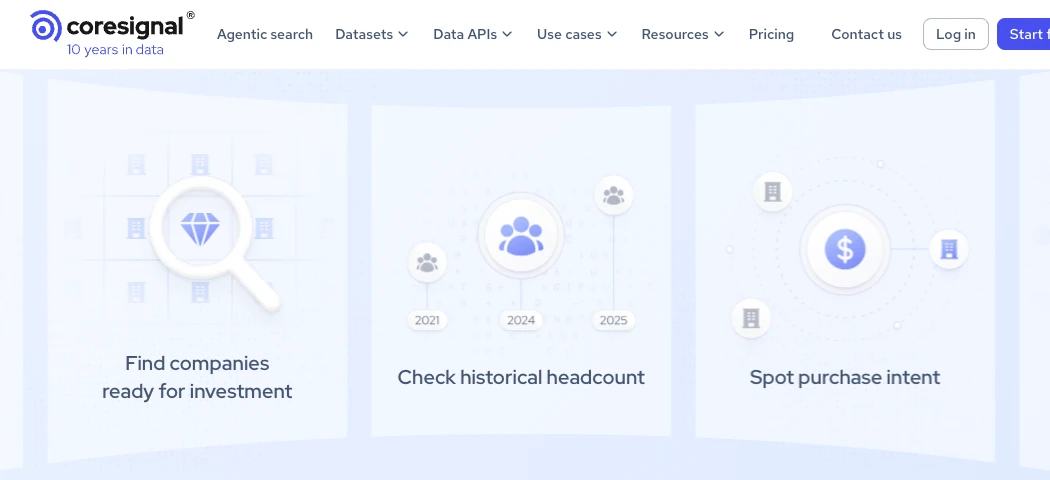
Coresignal specializes in alternative data, aggregating public web information from diverse data sources to deliver high-frequency employment metrics, firmographics, company reviews, and more. They structure this data strictly for technical teams, providing the raw feeds engineers need for advanced data modeling, training machine learning models, and powering internal algorithms.
Best for: Investment firms, venture capitalists, and data science teams building custom machine learning models or internal analytics pipelines.
Key strengths:
- Strong historical employment and job posting data for tracking company headcount and growth trends.
- High-frequency data updates provide near real-time market signals .
- Developer-focused delivery via APIs, flat files, and direct cloud storage integrations that help teams efficiently process data using specialized data services.
Possible limitations:
- Has no native visualization tools and requires engineering support for advanced API integrations.
- Pricing scales up significantly when requesting access to extensive historical data or multiple distinct data categories.
FactSet
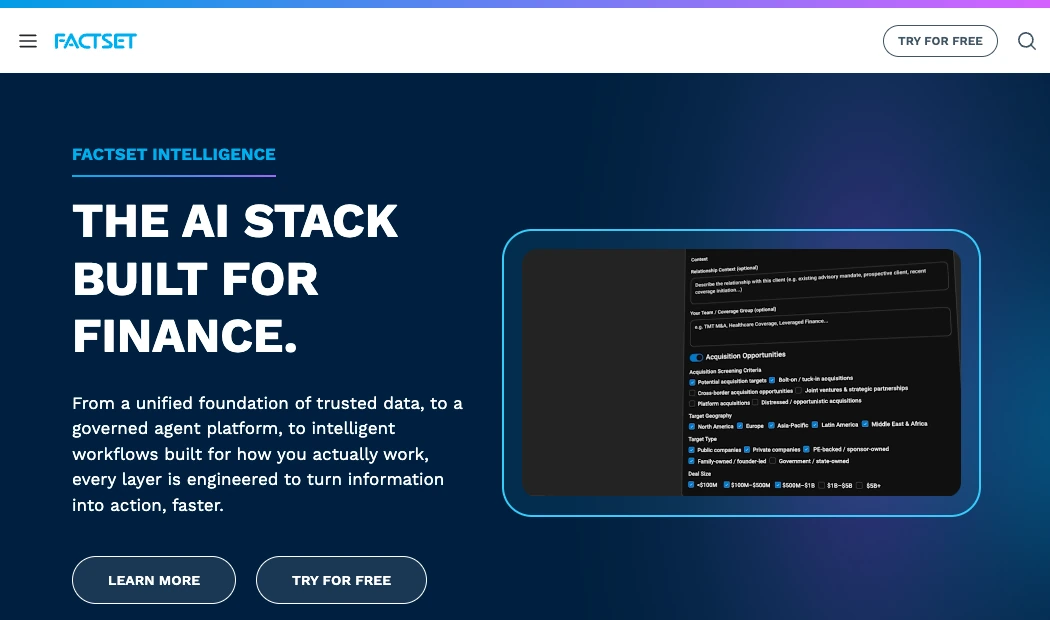
FactSet provides global market intelligence, economic indicators, and fundamental company metrics to the financial sector. While famous for their desktop workstation, their true DaaS value lies in their enterprise data feeds, which deliver structured financial data directly into modern data analytics pipelines and proprietary quantitative models to strengthen corporate data infrastructure.
Best for: Institutional investors, asset managers, and quantitative analysts who need reliable financial data feeds for proprietary trading algorithms and risk models.
Key strengths:
- Extensive historical coverage of global financial metrics and alternative datasets across millions of distinct data points gathered from international data sources.
- Flexible data delivery options, including APIs, standard flat files, and direct cloud integrations with platforms like Snowflake and AWS.
- Highly structured data architectures that make it easier to feed machine learning models.
Possible limitations:
- Premium enterprise pricing creates a high barrier to entry for smaller firms.
- The underlying financial data schemas are massive and highly complex, requiring dedicated data engineering time to map and integrate properly.
Cognism
Cognism focuses on accurate B2B contact data and European privacy compliance. They stand out in their data collection by choosing to manually collect data and verify their premium mobile numbers, which leads to higher connect rates for outbound sales teams.
Best for: B2B sales teams targeting European markets or organizations requiring strict GDPR compliance for their outreach.
Key strengths:
- Manually verified mobile numbers provide higher-than-average connect rates.
- Built from the ground up for strict GDPR compliance.
- Uncapped seat licenses for sales reps avoid the rigid credit tracking seen in competitor platforms.
Possible limitations:
- The North American database lacks the sheer volume offered by legacy US-based providers.
- Buyer intent data is powered by third-party providers like Bombora rather than proprietary native tracking.
Quick Comparison of the Best Data-as-a-Service Companies
While these platforms overlap in basic data coverage, each is built for a specific enterprise use case. Here is a quick breakdown to help you match the right vendor to your team.
| Provider | Best for | Key data types | Global coverage | Pricing |
|---|---|---|---|---|
| ZoomInfo | High-volume outbound | B2B contacts, intent (add-on) | Heavy NA, growing EMEA | ~$15,000/year |
| Dun & Bradstreet | Corporate risk assessment | Corporate hierarchies, financials | Extensive global | Ranges from $61.99/year to $50,000/year |
| Coresignal | Technical data teams | Raw firmographics, employment | Broad global | API access starts from $49/month, datasets start from $1,000 |
| FactSet | Institutional investing | Fundamental, market metrics | Extensive global | Ranges from $12,000 to $20,000 per user |
| Cognism | EMEA-focused calling | Verified mobile, B2B emails | Heavy EMEA, growing NA | ~$15,000/year |
How to Choose the Right Data-as-a-Service Company
Choosing the right DaaS provider requires mapping your internal workflows directly to a vendor’s core strengths. Mismatches lead to poor adoption, so you must evaluate their data acquisition methods rather than relying on marketing claims.
Choose Based on Data Type Requirements
Align your vendor choice with the specific data your team consumes from external data sources, as a single provider rarely serves every department well. Data scientists need structured, high-frequency raw data for advanced data modeling and predictive analytics.
Procurement teams require established corporate data providers for vendor risk assessments, while sales teams need accurate B2B contact info and verified phone numbers to build robust data solutions.
Choose Based on Integration Capabilities
Purchased data is useless if it sits isolated. You need reliable APIs, cloud warehouse connectors (like Snowflake or AWS), and direct CRM integrations that feed into your existing analytics tools.
Without these delivery formats, your team will waste hours on manual data management and tedious CSV uploads. Always verify how a provider’s feed integrates with your central data warehouse to optimize enterprise data management before signing a contract.
Choose Based on Compliance and Security Needs
Global regulatory scrutiny surrounding data security is tight, so you must verify that your vendor’s continuous data collection from public and private data sources complies with GDPR, CCPA/CPRA, and emerging AI data provenance laws.
The best vendors maintain comprehensive audit trails to facilitate accurate compliance data analysis and automatically sync suppression lists across your systems so you do not accidentally contact individuals who have opted out.
Which Data-as-a-Service Company Is Best for You?
There is no single best data platform. The right choice depends entirely on your regional focus, technical capabilities, and compliance requirements.
- ZoomInfo. Best for large North American outbound sales teams seeking vast data sources, though advanced features like intent data require premium add-ons.
- Dun & Bradstreet. Best for enterprise procurement teams that need D-U-N-S numbers to manage global corporate risk, verify vendors, and streamline overall vendor data management.
- Coresignal. Best for data science and engineering teams that rely on heavy data collection and need massive volumes of raw, web-scraped firmographics to feed internal models.
- FactSet. Best for institutional investors and quantitative analysts who need deep financial metrics and market data delivered via API for advanced data analytics.
- Cognism. Best for B2B sales teams targeting Europe that prioritize safe procedures to collect data, ensuring strict GDPR compliance and verified mobile numbers.
Conclusion
Your chosen DaaS provider is the driver for your outbound sales, continuous data collection, and internal analytics. Aligning your technical needs with the right vendor of modern data services prevents integration headaches, delivers scalable data solutions, and allows your team to focus on putting external data services to work rather than maintaining pipelines.